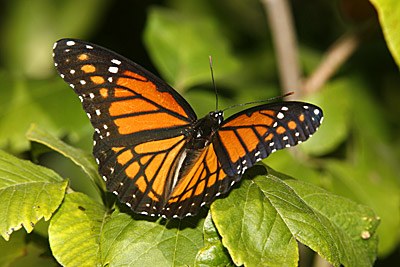
Viceroy
- Habitat
- Moist open/shrubby areas: lake/swamp edges, willow thickets, valley bottoms, wet meadows, roadsides
- Size
- 2½–3⅜ in (6.3–8.6 cm)
- Lifespan
- Adults typically live about 2 to 3 weeks, similar to the closely related Red-spotted Purple.
- Diet
- Caterpillar: willow family — willows, poplars, cottonwoods. Adult: early season aphid honeydew, carrion, dung, decaying fungi; later aster, goldenrod, joe-pye weed, shepherd's needle, Canada thistle
About the Viceroy
The Viceroy (Limenitis archippus) is a medium-large butterfly, 2½ to 3⅝ inches across, best known for its close resemblance to the Monarch, sharing the same bright orange wings crossed by bold black veins. The two are told apart by a distinctive black line that curves across the Viceroy's hindwing, absent in the Monarch, along with a single row of white dots running through the dark wing border rather than the Monarch's more scattered white spots. Where Monarchs are scarce, the southern populations of Viceroy instead mimic the closely related Queen butterfly, adjusting their appearance to match whichever toxic model is common locally. For decades this resemblance was treated as a textbook case of Batesian mimicry, a harmless species copying a toxic one, but research over the past few decades has found that Viceroys themselves are somewhat unpalatable, likely owing to compounds picked up from willow-family host plants, which suggests the relationship functions more as Mullerian mimicry, two distasteful species converging on a shared warning pattern that reinforces the lesson for predators faster than either species could alone.
This species sticks close to water and moist ground, inhabiting lake and swamp edges, willow thickets, valley bottoms, wet meadows, and damp roadsides across most of North America. Its dependence on wet habitats sets it apart from the drier, more open country favored by some of its Admiral relatives.
Caterpillars feed exclusively on plants in the willow family, including willows, poplars, and cottonwoods, and are notable for resembling bird droppings in their early stages, a camouflage strategy that helps them avoid predators while young; older caterpillars develop a lumpy, olive-brown, somewhat antler-horned profile that continues the disguise into later instars. Adults shift their feeding through the season, relying early on aphid honeydew, carrion, dung, and decaying fungi before turning later in the year to flowers such as aster, goldenrod, joe-pye weed, shepherd's needle, and Canada thistle.
Females lay only two or three eggs per host plant rather than depositing them in large batches, spreading their offspring across many trees. Adults typically live about two to three weeks, similar in lifespan to the closely related Red-spotted Purple, and long-standing evidence indicates the mimicry works in both directions, with predators that have had a bad experience with either a Monarch or a Viceroy tending to avoid both going forward.
Adults typically rest and bask with their wings spread flat, a habit shared with Monarchs, though their flight tends to be a bit more direct, with shorter glides between wingbeats. Rather than overwintering as an adult, the Viceroy spends the cold months as a partly grown caterpillar, curling a single leaf into a small shelter called a hibernaculum and fastening it to a twig with silk before settling in to hibernate until the host tree leafs out again in spring, at which point it emerges to resume feeding on the fresh new growth.
Classic feeding experiments conducted decades ago, offering wild birds a choice between Viceroys, Monarchs, and palatable control butterflies, were instrumental in establishing this mimicry relationship as a serious subject of study, and the Viceroy remains one of the most frequently cited examples of mimicry in general biology textbooks as a result. Because Viceroys and Monarchs often fly through the same wet meadows and streamside habitats during the warmer months, a quick look at wingbeat style and hindwing pattern is usually enough to separate the two species even at a distance, well before a closer look at the diagnostic black hindwing line becomes necessary.
Frequently asked questions
How do you tell a Viceroy from a Monarch?
Look for a black line curving across the Viceroy's hindwing and a single row of white dots in the wing border, both of which the Monarch lacks.
What do Viceroy caterpillars eat?
They feed exclusively on willow-family plants such as willows, poplars, and cottonwoods.
Why does the Viceroy mimic the Monarch?
The resemblance likely deters predators that have learned to avoid the Monarch's unpleasant taste; where Monarchs are scarce, Viceroys instead resemble the similarly distasteful Queen butterfly.
How many eggs does a female Viceroy lay per plant?
Typically just two or three eggs per host plant, spreading her offspring across many different trees.
Is the Viceroy actually distasteful like the Monarch?
Research suggests Viceroys are somewhat unpalatable in their own right, likely from compounds picked up in willow-family host plants, making the resemblance more a case of mutual mimicry than one-sided copying.
Where to find it
This species favors wetland habitat. See real Oklahoma locations on the Habitats map.