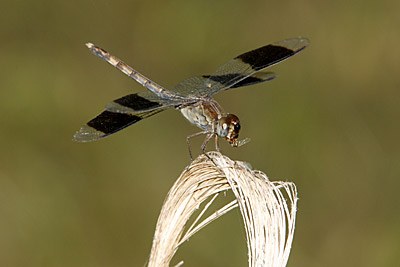
Band-winged Dragonlet
Erythrodiplax umbrata
- Habitat
- Temporary pools and marshes with sparse or tall shoreline vegetation; notably tolerant of brackish or saline water.
- Size
- A medium-sized skimmer; a precise species-specific measurement was not confidently confirmed, so an approximate range in the neighborhood of 1.5 to 1.7 inches is offered rather than a confirmed figure.
- Lifespan
- Not specifically documented; likely a few weeks as an adult, consistent with related skimmers.
- Diet
- Adults catch flying insects on the wing; nymphs prey on aquatic invertebrates and can tolerate somewhat saline conditions unusual for dragonfly larvae.
About the Band-winged Dragonlet
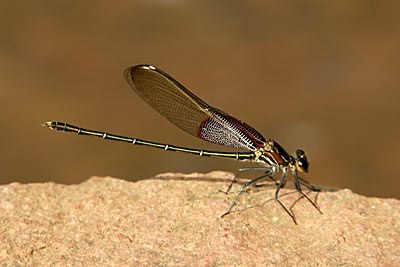
The Band-winged Dragonlet is a dark, slender, mid-sized skimmer, and the male is essentially unmistakable thanks to a large, rectangular black band running across the middle of each wing toward the pterostigma. Females are more variable: some develop wing bands similar to the male's, a pattern known as the andromorph form, while most instead lack wing markings entirely and appear as a fairly plain, drab brown, a form called the heteromorph. These plainer females can still be identified by dark brown marks along the side of the abdomen that point forward, a helpful detail when the diagnostic wing band is absent.
This species occupies a broad range across the Caribbean, Central America, North America, and South America, and it reaches into the warmer parts of the south-central United States, including southern Oklahoma and Texas, particularly during warmer months. Its preferred habitats are temporary pools and marshes bordered by either sparse or tall shoreline vegetation.
One of the more notable aspects of the Band-winged Dragonlet's natural history is its adaptability to challenging water conditions: the species can survive in stressful, marginal habitats and shows real tolerance for the kinds of temporary, sometimes brackish or otherwise stressed water bodies that many other dragonflies avoid. This flexibility likely helps explain its very wide geographic distribution across such varied climates and habitats.
Adults hunt flying insects in typical skimmer fashion, and breeding follows the general pattern of egg-laying directly into open water, with nymphs developing among sediment and vegetation in these often temporary pools, adapted to tolerate fluctuating or marginal water quality through their larval stage before emerging as adults. Because temporary pools can dry up unpredictably, this tolerance for less stable conditions is likely a key part of how the species persists across such a wide range of habitats and climates. Because temporary pools can dry up entirely within a season, nymphs of this species likely develop unusually quickly compared with dragonflies tied to permanent water, though detailed developmental timelines specific to this species were not confidently found. Its willingness to breed in marginal, sometimes brackish habitats means it can turn up at roadside ditches and seasonal wetlands that many other dragonflies would simply avoid.
Frequently asked questions
How can you identify a male Band-winged Dragonlet?
By the large, rectangular black band crossing the middle of each wing, a distinctive and largely unmistakable mark.
Do all Band-winged Dragonlet females have banded wings?
No, most females lack wing bands and appear plain brown, though some develop male-like banded wings.
What makes this species notably adaptable?
It tolerates temporary pools and even somewhat brackish or saline water, conditions many other dragonflies avoid.
How wide is its overall range?
Very wide, spanning the Caribbean, Central America, North America, and South America.
Where to find it
This species favors wetland habitat. See real Oklahoma locations on the Habitats map.