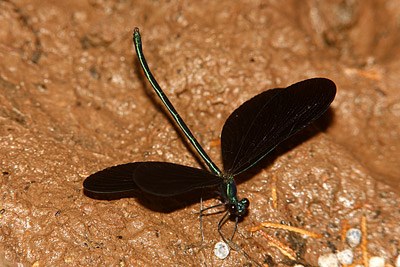
Ebony Jewelwing
Calopteryx maculata
- Habitat
- Shaded, slow-moving woodland streams and creeks with clean water
- Size
- Body length about 1.5-2 in (38-50 mm)
- Lifespan
- Adults typically live only a few weeks during the flight season; the aquatic nymph stage before that can last close to a year
- Diet
- Adults hunt small flying insects such as midges and small flies; aquatic nymphs prey on small invertebrates
About the Ebony Jewelwing
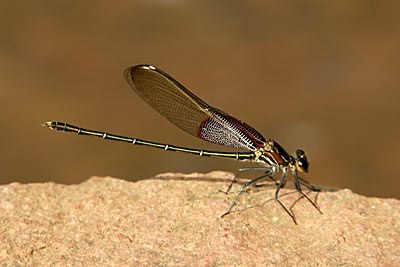
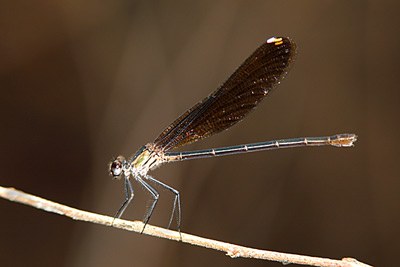
The Ebony Jewelwing is a large, showy damselfly named for its metallic, jewel-like sheen, among the most conspicuous and frequently noticed damselflies in the wooded stream habitats where it occurs. Males have an iridescent emerald-green to blue-black body and entirely dark, blackish wings without any clear patches, while females are duller bronze-green with smoky brown-gray wings marked by a small white spot, called a pseudostigma, near each wingtip. This wing difference makes the sexes easy to tell apart even in flight, and unlike most dragonflies and damselflies, jewelwings fly with a slow, fluttering, almost butterfly-like wingbeat rather than the fast, buzzy flight typical of the group, a distinctive travel style that often catches the eye of an observer before any color or pattern does.
The species is found along shaded, slow-flowing woodland streams and creeks throughout much of eastern North America, including wooded areas of Oklahoma, and it is closely tied to clean, well-oxygenated water; because it is sensitive to pollution and habitat degradation, its presence is often taken as a rough indicator of relatively good water quality in a stream. It is generally replaced farther west, in parts of the southern Great Plains and Southwest, by its close relative the Sparkling Jewelwing, which shows a small clear patch near each wingtip that the all-dark-winged Ebony Jewelwing lacks.
Adult Ebony Jewelwings hunt small flying insects such as midges, small flies, and mosquitoes, typically sallying out briefly from a perch near the stream bank to catch prey in flight before returning to a favored perch. Before reaching adulthood, the species spends an extended period, often close to a year, as an aquatic nymph, living among submerged vegetation and debris in the stream and preying on smaller aquatic invertebrates while it grows through a long series of molts.
Males defend stretches of stream as territories and perform conspicuous courtship displays involving fluttering flight and wing-flashing to attract females and to signal to rival males, a display made especially visible by the stark contrast of the male's dark wings against dappled stream-side light. Rival males also engage in brief chases and wing-clapping confrontations along the disputed stretch of bank, generally without physical contact, before one retreats.
After mating, females lay their eggs directly into the tissue of submerged or floating plants, and they are capable of submerging entirely underwater for extended periods while ovipositing, an unusual behavior that exposes them to additional predation risk but allows eggs to be placed directly into a suitable aquatic environment; a submerged female can sometimes remain underwater for close to half an hour before surfacing again. Adults typically live only a few weeks, but because they emerge in a fairly extended pulse through late spring and summer, a shaded stream can host active Ebony Jewelwings for a good portion of the warm season.
The nymphs themselves are slender and stick-like, colored in mottled greens and browns that blend well with submerged twigs and leaf litter, and they breathe through three long, leaf-shaped gills at the tip of the abdomen rather than the internal gill chamber used by dragonfly nymphs, a structural difference that separates damselfly larvae from their more robust dragonfly cousins at a glance. Because the species is so widespread and conspicuous across the wooded East, it is often one of the first damselflies newcomers to the hobby learn to identify, and its combination of large size, metallic color, and slow, fluttering flight makes it a reliable confidence-builder before tackling trickier, smaller species.
Frequently asked questions
Why are they called "jewelwings"?
Their name comes from the iridescent, jewel-like metallic green or blue sheen of their bodies and, in males, their dark wings.
How can you tell males and females apart?
Males have solid black wings, while females have smoky brown wings with a small white spot near each wingtip.
Where do Ebony Jewelwings live?
Along shaded, slow-flowing woodland streams with clean water, common across the eastern half of North America.
How long do Ebony Jewelwings live?
Adults typically live only a few weeks, though the aquatic nymph stage before that can last close to a year.
How does the Ebony Jewelwing's flight differ from other damselflies?
It flies with a slow, fluttering, almost butterfly-like wingbeat rather than the fast, buzzy flight typical of most dragonflies and damselflies.
Where to find it
This species favors wetland habitat. See real Oklahoma locations on the Habitats map.