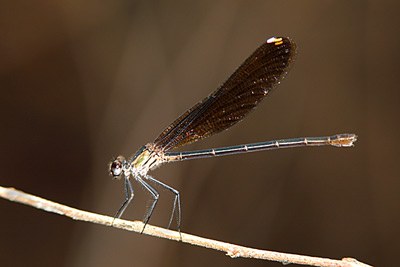
Smoky Rubyspot
Hetaerina titia
- Habitat
- Streams and rivers, often similar to or slightly more turbid than American Rubyspot habitat
- Size
- Body length about 1.5-1.8 in (38-46 mm)
- Lifespan
- Adults typically live only days to a few weeks during the flight season
- Diet
- Adults catch small flying insects; aquatic nymphs prey on smaller invertebrates
About the Smoky Rubyspot
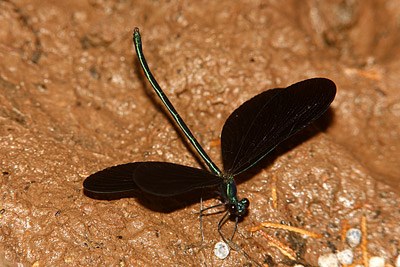
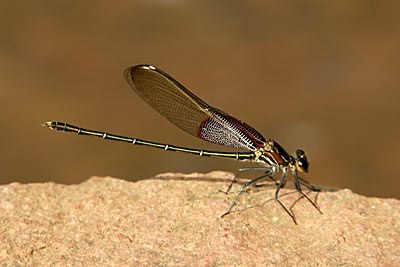
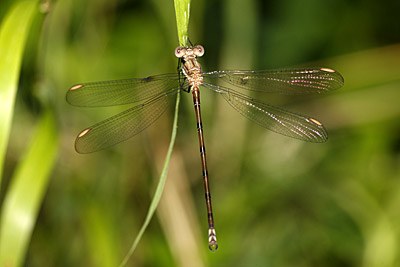
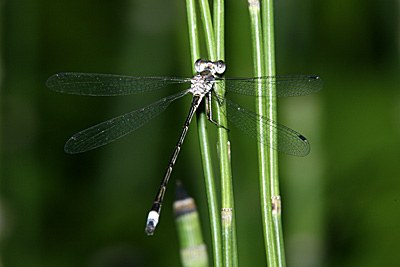
The Smoky Rubyspot closely resembles its relative the American Rubyspot but can be distinguished by its wing pattern: males show a deep red patch at the base of the wing that extends further outward, combined with darker, smoky-brown to blackish wingtips, giving the species a noticeably darker overall appearance in flight compared to the American Rubyspot's clearer wingtips. Females are duller brown, similar in general pattern to female American Rubyspots, which can make the two species genuinely difficult to separate without close observation of wing shading, and even experienced observers sometimes need a photograph in hand to be fully confident of an identification.
The species occurs across the southern and eastern United States, including suitable stream and river habitat in Oklahoma, and it frequently occurs alongside the American Rubyspot in the same streams, since the two share broadly similar habitat preferences for flowing water with sunny, open stretches. Flight season generally spans the warmer months, roughly from late spring into early fall, mirroring the flight period of its close relative.
Like its relative, the Smoky Rubyspot is a sit-and-wait aerial hunter as an adult, perching over the water and darting out to catch small flying insects, while its aquatic nymphs live among submerged rocks and vegetation, preying on smaller invertebrates during the underwater phase of the life cycle, a stage that may last a year or more depending on water temperature.
Males defend perches over the stream in a manner very similar to the American Rubyspot, engaging rivals with brief aerial chases and wing displays that show off the dark wingtips, and the two species' overlapping ranges and similar behavior mean that careful attention to wing coloration, particularly the extent and shade of the wingtip darkening, is often necessary to confirm identification in the field.
Breeding behavior follows the same general pattern as other rubyspots, with females laying eggs into submerged plant material after mating, often while still attached to the male in tandem as a form of mate guarding, and nymphs developing underwater before emerging as adults, typically over the warmer months of the year. Because the two rubyspot species overlap so extensively, a stream hosting healthy numbers of both is a modestly encouraging sign of good water quality supporting a diverse damselfly community.
Like the American Rubyspot, the Smoky Rubyspot nymphs are flattened and cryptically colored to blend with submerged rocks and debris, using camouflage and a final rapid strike, rather than active pursuit, to capture smaller invertebrates drifting past in the current. Emergence typically occurs on streamside rocks or emergent vegetation just above the waterline, where the newly transformed adult clings motionless while its wings harden and its exoskeleton darkens to the adult coloration over the course of an hour or more, a vulnerable period during which the teneral adult is especially exposed to predators.
Across much of its combined range with the American Rubyspot, the Smoky Rubyspot tends to be the less numerous of the two species, though local proportions can vary considerably from one stream to the next depending on subtle differences in current speed, streambed composition, and water chemistry that are not yet fully understood. Because the two species' nymphs likely have similar habitat requirements, a stream supporting healthy numbers of one rubyspot species is a reasonable, though not certain, predictor of finding the other nearby as well.
Frequently asked questions
How can you distinguish the Smoky Rubyspot from the American Rubyspot?
The Smoky Rubyspot has darker, smoky-tipped wings extending further from the red base patch, giving it a noticeably darker overall look.
Where would you find Smoky Rubyspots in Oklahoma?
Along streams and rivers, often in the same habitats used by American Rubyspots.
What do Smoky Rubyspot nymphs eat?
Like other damselfly nymphs, they are aquatic predators feeding on small invertebrates in the water.
Do Smoky Rubyspots and American Rubyspots ever occur together?
Yes, their ranges and habitats overlap significantly, and careful attention to wing pattern is needed to tell them apart.
Can Smoky Rubyspots and American Rubyspots be told apart easily?
Not always at a glance; reliable separation often depends on close observation of how far the dark, smoky wingtip shading extends beyond the red base patch.
Where to find it
This species favors wetland habitat. See real Oklahoma locations on the Habitats map.