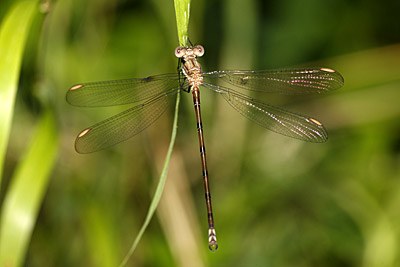
Great Spreadwing
Archilestes grandis
- Habitat
- Shaded ponds, spring-fed pools, and slow woodland streams lined with overhanging trees and shrubs
- Size
- About 2.0 to 2.3 inches (50-58 mm) long, the largest spreadwing in North America
- Lifespan
- Individual adult lifespan is not well documented for this species, but like other spreadwings adults are thought to survive roughly several weeks during their late-summer flight period
- Diet
- Adults take small flying insects such as gnats, mosquitoes, and other soft-bodied insects caught on the wing; nymphs prey on aquatic insect larvae and other small invertebrates in the water
About the Great Spreadwing
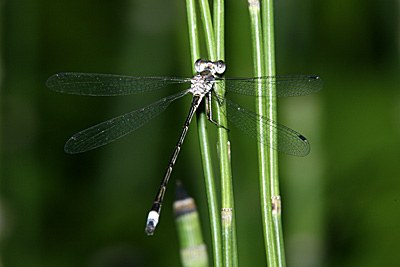
The Great Spreadwing is the largest of the spreadwing damselflies found in Oklahoma, and its size alone often gives it away in the field. Adults have a metallic bronze-green thorax and abdomen, pale blue eyes, and whitish terminal appendages at the tip of the abdomen that stand out even in flight. Like other members of the genus Archilestes and the family Lestidae, it habitually perches with its wings held open at an angle rather than folded flat over the back, the trait that gives spreadwings their common name.
This species favors shaded, often intermittent or semi-permanent water bodies bordered by woody vegetation - farm ponds, spring seeps, and slow backwater stretches of streams with overhanging branches are typical haunts in Oklahoma. It tends to perch on twigs and foliage well away from open water, only approaching the pond or stream margin to feed or breed, which makes it feel less tied to water than many damselflies during the day.
As an adult it hunts by sallying from a perch to snatch small flying insects such as midges, gnats, and mosquitoes, then returning to a nearby perch to consume them. The nymphs, which live underwater for months before emergence, are active predators of mosquito larvae, small aquatic worms, and other soft-bodied invertebrates.
One of the more distinctive aspects of Great Spreadwing biology is its late flight season and unusual egg-laying habit. It is one of the last damselflies flying in Oklahoma each year, commonly seen from late summer into autumn. Mated pairs lay eggs not directly into water but into the tissue of twigs and stems overhanging a pond or stream, often well above the current water line. The eggs overwinter in the plant tissue and the emerging nymphs drop into the water the following spring when rains raise the water level beneath them, an adaptation that lets the species use shallow or seasonal pools that would not hold water long enough for a spring-laid egg to develop. Mated pairs typically remain in tandem throughout the egg-laying process, with the male continuing to grip the female behind the head to guard against rival males until she has finished ovipositing into the twig or stem tissue. This species also appears to have been slowly expanding its range northward across parts of the central United States in recent decades, a trend noted in several regional odonate surveys.
Frequently asked questions
How can I tell a Great Spreadwing from other damselflies?
Its large size, bronze-green body, and habit of perching with wings spread open rather than closed make it stand out from smaller, closed-wing damselflies like bluets and dancers.
When is the best time to see Great Spreadwings in Oklahoma?
Look for them from late summer into fall, since this species flies later in the year than most other damselflies.
Why does it lay eggs in twigs instead of directly in the water?
Females insert eggs into overhanging plant stems, where they overwinter and only hatch the following spring when rising water reaches them, an adaptation suited to temporary pools.
What do Great Spreadwings eat?
Adults catch small flying insects like gnats and mosquitoes in flight, while the aquatic nymphs feed on mosquito larvae and other small invertebrates.
Where to find it
This species favors wetland habitat. See real Oklahoma locations on the Habitats map.