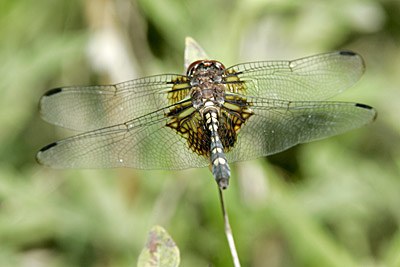
Black Saddlebags
Tramea lacerata
- Habitat
- Open sky over ponds, lakes, and fields; a strong, high-flying glider found throughout Oklahoma
- Size
- About 1.9 to 2.2 inches (48–56 mm) long
- Lifespan
- Likely several weeks as a flying adult; the species is also known for wandering, sometimes migratory movements over open country
- Diet
- Adults catch flying insects on the wing, including flying ants, mosquitoes, and other small insects, sometimes hunting in loose groups; nymphs prey on aquatic invertebrates and small aquatic organisms
About the Black Saddlebags
The Black Saddlebags is named for the large, dark brown-to-black patches at the base of each hindwing, which resemble a pair of saddlebags slung beneath the body when the dragonfly is seen from below in flight. The rest of the body is a deep black with little contrasting pattern, and combined with the dark wing patches, this gives the species a bold, almost silhouette-like appearance against a bright sky, quite different from the paler and more patterned skimmers on this list. It is also a notably large, powerful flier, with broad wings suited to extended gliding rather than the short hovering flights typical of many pond-perching species.
It ranges across nearly all of the United States, including throughout Oklahoma, and is most often encountered flying high over open ponds, lakes, fields, and even parking lots or open ground well away from water, since adults spend much of their time on extended patrol or hunting flights rather than resting near the shoreline. It rarely perches for long, and when it does, it typically hangs vertically from a twig rather than resting horizontally the way most skimmers do, a distinctive posture that can help confirm identification even at a distance.
Adults are aerial hunters that catch flying insects, including flying ants, mosquitoes, and other small prey, directly out of the air during long gliding flights, and they are sometimes seen foraging in loose aggregations, taking advantage of insect swarms stirred up over fields or emerging in large numbers from the water. This ability to travel widely in search of abundant prey is one of the more distinctive aspects of the species' hunting behavior compared to the more sedentary, perch-bound style of many other skimmers. The aquatic nymphs live in ponds and lakes among sediment and submerged debris, where they prey on aquatic invertebrates and other small aquatic organisms using the extendable hinged jaw typical of dragonfly larvae.
Breeding takes place over open ponds and lakes, where males patrol territory and mate with females that enter the area; egg-laying occurs directly onto the water's surface, often with the pair still in tandem. Like several other wide-ranging skimmers, the Black Saddlebags is known to make substantial seasonal movements, and large numbers are sometimes observed migrating together, particularly in fall, adding to its reputation as one of the more mobile and far-traveling dragonflies found in Oklahoma.
Frequently asked questions
Why is it called the Black Saddlebags?
The large dark patches at the base of each hindwing resemble a pair of saddlebags when seen from below in flight.
Does it perch like other dragonflies?
Rarely, and when it does, it typically hangs vertically from a twig rather than resting flat the way most skimmers do.
Is it a migratory species?
It is known to make substantial seasonal movements, and groups are sometimes observed migrating together, especially in fall.
Where is it usually seen?
High over open ponds, lakes, and fields, often well away from the water's edge, since it spends much of its time on extended flights.
Where to find it
This species favors wetland habitat. See real Oklahoma locations on the Habitats map.