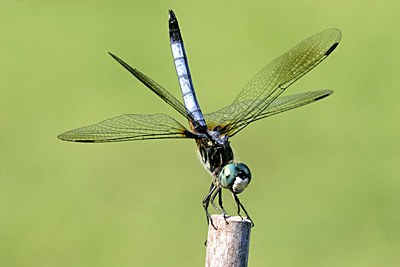
Blue Dasher
Pachydiplax longipennis
- Habitat
- Ponds, lakes, marshes, and slow streams with abundant vegetation, one of the most widespread dragonflies in North America
- Size
- About 1.0 to 1.3 inches (25–33 mm) long, a small skimmer
- Lifespan
- Typically a few weeks as a flying adult, consistent with other small skimmers, though wild lifespans are not precisely documented
- Diet
- Adults catch small flying insects such as mosquitoes, gnats, and midges; nymphs prey on mosquito larvae and other small aquatic invertebrates
About the Blue Dasher
The Blue Dasher is a small but strikingly marked skimmer, with mature males developing a powdery blue abdomen, a green or blue-green thorax, and vivid green eyes that meet at the top of the head, a combination that makes it one of the easier small dragonflies to identify. Females and immature males keep a brown-and-yellow striped pattern rather than the blue pruinosity, but share the same bright green eyes, which remain one of the species' best field marks at any age. Its wings often show a faint amber tint near the base, and its small size compared to the larger Libellula skimmers sharing its habitat further helps confirm identification.
This is one of the most widespread and abundant dragonflies in North America, found in nearly every U.S. state and common throughout Oklahoma wherever there is standing water with reasonable vegetation, from farm ponds and lake margins to marshes and slow streams. It has a very characteristic perching posture, often resting on the tip of a reed or twig with its abdomen raised at an angle, sometimes described as an "obelisk" posture, which is thought to help the dragonfly regulate its body temperature by reducing the surface area exposed to direct sun.
Adults hunt by darting out from a low perch to snatch tiny flying insects such as mosquitoes, gnats, and midges, a rapid, energetic style that gave the species its common name, and they will readily return to the same perch repeatedly between hunting sorties. The aquatic nymphs live among submerged plants and detritus in still or slow water, where they are effective ambush predators of mosquito larvae and other small aquatic invertebrates, making the species a genuinely useful natural check on mosquito populations around ponds.
Males defend small territories over open water, often just a few square feet, and mate with visiting females; the female then lays eggs directly into the water, frequently without extended guarding by the male, in contrast to some larger skimmers. Given its abundance, rapid generation cycle in warm climates, and tolerance of a wide range of still-water habitats, the Blue Dasher is likely one of the very first dragonflies most Oklahoma pond-watchers will encounter.
Frequently asked questions
Why is it called the Blue Dasher?
Mature males have a powdery blue body, and the species has a quick, darting flight style when hunting small insects, together giving rise to the name.
How can I recognize a female Blue Dasher?
Females lack the blue body of males but share the same bright green eyes and a brown-and-yellow striped pattern, and are noticeably smaller than most other pond skimmers.
Why does it perch with its abdomen raised?
This "obelisk" posture is thought to help the dragonfly reduce heat gain by minimizing the body surface exposed directly to the sun.
Is it common in Oklahoma?
Yes, it is one of the most widespread and frequently seen dragonflies in the state, found at almost any pond, lake, or marsh with some vegetation.
Where to find it
This species favors wetland habitat. See real Oklahoma locations on the Habitats map.