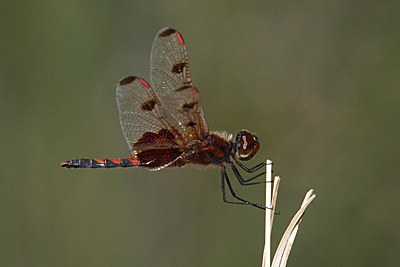
Calico Pennant
Celithemis elisa
- Habitat
- Vegetated ponds, lakes, borrow pits, and stream pools with emergent plants or marshy borders.
- Size
- About 24 to 34 mm long (roughly 1 to 1.3 inches), with a hindwing length of 25 to 30 mm.
- Lifespan
- Not specifically documented; likely a few weeks as an adult, typical for smaller skimmer-family dragonflies.
- Diet
- Adults feed on small flying insects, including mosquitoes and flies, caught on the wing near vegetation.
About the Calico Pennant
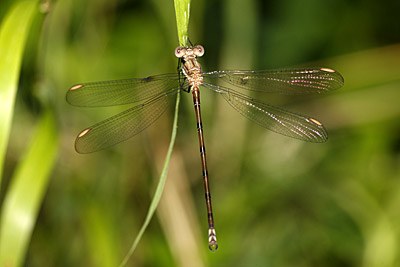
The Calico Pennant is a small, colorful skimmer, among the more compact dragonflies in its family at a bit over an inch in length, named for its patchwork appearance, with brown spots marking the base and tip of each wing and a pterostigma that starts yellow in younger individuals and reddens with age. The face also shifts from yellow to red as males mature, and the thorax is yellow-brown with one large dark stripe accompanied by several smaller brown stripes. Perhaps its best-known feature is a row of small, heart-shaped red spots running down the top of the male's abdomen, a detail that has made this species a favorite among casual dragonfly watchers and one of the more reliably charming small dragonflies to photograph well. Females show a more muted yellowish or brown version of the same wing and body pattern, with the heart spots typically appearing as yellow rather than red.
This species is native to eastern Canada and the eastern United States, where it favors calm, vegetated water bodies. Typical habitats include ponds, lakes, borrow pits, and stream pools that have emergent plants or marshy, vegetated borders, conditions found at many farm ponds and small lakes across Oklahoma. Because it tolerates a range of pond conditions, from clean natural ponds to more disturbed farm impoundments, it is one of the more widely encountered small pennants in the state. Flight season in Oklahoma generally runs from late spring through summer, with adults most numerous during the warmest months when pond vegetation is fully grown in.
Adults are active hunters of small flying insects, including mosquitoes and flies, snatching prey out of the air near the vegetation where they perch. Between hunting flights, Calico Pennants commonly cling to the very tips of grass stems, reeds, or other emergent plants, often angling their wings forward rather than holding them flat, a posture shared with several of their pennant relatives and one that may help reduce the body's exposure to direct sun during the hottest part of the day.
Breeding follows the general skimmer pattern, with females tapping the abdomen against the water's surface to release eggs directly into it near the emergent vegetation where adults spend most of their time, often while still linked to the male in tandem for at least part of the process as a form of mate guarding. The resulting nymphs develop among submerged plant stems and debris, preying on other small aquatic invertebrates, before eventually climbing out of the water to emerge as adults.
The male's heart-spotted abdomen remains the species' signature feature and one of the more charming, easily appreciated details among Oklahoma's smaller dragonflies. Because it is small, brightly marked, and often willing to perch still for long stretches at the tip of a favorite grass stem, the Calico Pennant is frequently one of the easier pennants for beginning dragonfly watchers to photograph well. Its preference for well-vegetated pond and lake margins also means mowing or clearing shoreline plants too aggressively can reduce its local numbers, making a little tolerance for shaggy pond edges a small but meaningful gesture for landowners.
The Calico Pennant is sometimes confused at a glance with the larger, more boldly banded Halloween Pennant, another Oklahoma pond species that shares the habit of perching at the tips of grass stems, but the Calico Pennant's smaller size, more scattered wing spotting, and the male's distinctive heart-shaped abdominal markings usually settle the identification once the insect is seen well. Because both species often forage over the same ponds at the same time of year, a pond hosting a good mixed population of pennants can be a particularly rewarding stop for comparing the two side by side.
Frequently asked questions
What is the most recognizable feature of a male Calico Pennant?
A row of small, heart-shaped red spots running down the top of the abdomen.
What kind of water does the Calico Pennant prefer?
Calm, vegetated ponds, lakes, borrow pits, and stream pools with emergent plants or marshy borders.
What do adult Calico Pennants eat?
Small flying insects, including mosquitoes and flies, caught in flight near vegetation.
How do Calico Pennants typically perch?
Clinging to the tips of grass stems or reeds, often holding their wings angled forward rather than flat.
Why is the Calico Pennant a good species for beginners to photograph?
It is small and brightly marked but often perches still for long stretches at the tip of a favorite grass stem, giving patient observers an easy, steady shot.
Where to find it
This species favors wetland habitat. See real Oklahoma locations on the Habitats map.