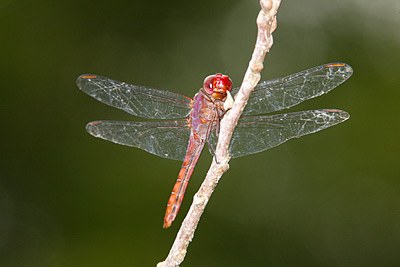
Carmine Skimmer
Orthemis discolor
- Habitat
- Swampy areas and open water with tall perches available; in the United States, confined to south and central Texas at the edge of a much wider tropical range.
- Size
- Males about 2 to 2.1 inches (52-54 mm) long, with a wingspan around 90 mm and hindwing length of about 40 mm.
- Lifespan
- Not specifically documented; likely several weeks as an adult, and in warmer parts of its tropical range it may fly nearly year-round, though its U.S. flight season is more seasonal.
- Diet
- Adults catch flying insects on the wing; nymphs prey on aquatic invertebrates in pond and marsh sediment.
About the Carmine Skimmer
The Carmine Skimmer is a vividly colored dragonfly whose mature males develop an overall plum-purple to carmine-red coloring across the head, thorax, abdomen, and appendages, paired with clear wings marked by thin black veins. Younger individuals look quite different, starting out brown before passing through a scarlet phase on the way to the deep, uniform coloring of a fully mature male. It closely resembles the more widespread Roseate Skimmer, and the two are best separated by subtle differences in wing venation rather than color alone, since both species show similar reddish-pink tones.
In the United States, the Carmine Skimmer occurs only in south and central Texas, placing the species at the northern edge of a much larger range that extends south through the Caribbean and Central America all the way to Uruguay in South America. This makes it primarily a tropical dragonfly that just reaches into the southern edge of the region covered by this guide, rather than a species regularly expected in Oklahoma itself.
Adults favor sites with tall perches available nearby, from which they can watch for both prey and rivals, and they are often seen in swampy areas, becoming especially active and visible during sunny weather or even good rainy-day conditions in the warmer parts of their range. In tropical portions of its distribution, the species reportedly flies close to year-round, though its more northern Texas populations likely follow a more clearly defined seasonal flight period tied to the region's cooler winters.
Breeding follows the general skimmer pattern, with females laying eggs into open or swampy water and nymphs developing among sediment and vegetation, preying on other aquatic invertebrates through an extended larval stage before emerging as adults that then pass through the brown-to-scarlet-to-purple color progression typical of the species as they mature. Because it barely reaches the United States at all, occurring only in south and central Texas, a Carmine Skimmer sighting anywhere in the broader Oklahoma region would represent a genuinely notable record rather than a routine one. Its close resemblance to the more widespread Roseate Skimmer also means careful photographs, ideally showing wing venation clearly, matter for confirming identification rather than relying on color alone.
Frequently asked questions
How can you tell a Carmine Skimmer from the similar Roseate Skimmer?
The two are best separated by subtle differences in wing venation, since both show similar reddish-pink coloring.
Where does the Carmine Skimmer occur in the United States?
Only in south and central Texas, at the northern edge of a range extending south through Central America to Uruguay.
How does the Carmine Skimmer's color change as it matures?
It starts out brown, passes through a scarlet phase, and finally develops the deep plum-purple to carmine coloring of a mature male.
What kind of perches does it favor?
Tall perches near swampy areas and open water, from which it watches for prey and rivals.
Where to find it
This species favors wetland habitat. See real Oklahoma locations on the Habitats map.