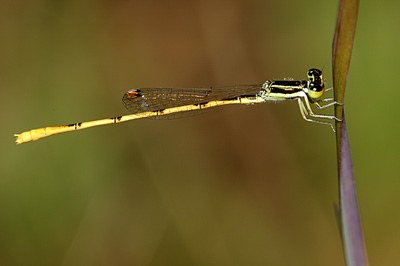
Citrine Forktail
Ischnura hastata
- Habitat
- Marshy pond and lake edges with sedges, grasses, and other low emergent vegetation
- Size
- About 0.8 to 1.0 inch (20-25 mm) long, one of the smallest damselflies in North America
- Lifespan
- Not well documented for this species specifically; small damselflies of this kind generally fly for a few weeks as adults
- Diet
- Adults hunt tiny flying insects such as small gnats and midges; nymphs feed on tiny aquatic invertebrates
About the Citrine Forktail
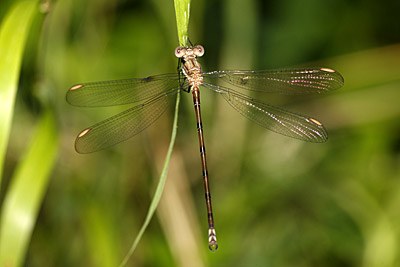
Citrine Forktail is among the smallest damselflies found in North America, and its size alone is often enough to separate it from most other species sharing the same marshy pond edges. Mature males have a yellow-orange thorax, which fades toward more muted tones with age, combined with a very slender, mostly dark abdomen typical of forktails, the small-bodied genus Ischnura within the bluet family Coenagrionidae.
This species favors marshy edges of ponds and lakes with dense stands of sedges, grasses, and other low emergent vegetation, where its diminutive size and tendency to perch low in dense growth can make it easy to overlook even where it is fairly common. Adults hunt tiny flying insects such as small gnats and midges, making brief flights from a perch within the vegetation before returning to rest.
Citrine Forktail holds a genuinely unusual distinction within the entire order Odonata: populations in the Azores islands reproduce by parthenogenesis, meaning females there produce viable offspring without needing to mate with a male at all, a reproductive strategy essentially unknown elsewhere among dragonflies and damselflies worldwide. Populations in North America, including any found in Oklahoma, reproduce normally through mating between males and females, but the existence of an all-female, self-cloning population on a remote island group elsewhere in this species' range is one of the more remarkable facts in odonate biology and makes Citrine Forktail a minor case study for scientists studying how and why asexual reproduction evolves in animals that normally require a mate.
In typical sexually reproducing populations, tandem pairs mate and females lay eggs into plant tissue at or near the waterline, after which nymphs develop among the same dense marshy vegetation adults favor, feeding on tiny aquatic invertebrates as they grow through a series of molts before eventually emerging as adults. Given its tiny size and preference for dense marsh vegetation, Citrine Forktail is one of the more challenging Oklahoma damselflies to spot, but the search is worthwhile for anyone interested in a species with such an unusual claim to scientific fame. In sexually reproducing populations, mated pairs remain in tandem while the female deposits eggs into plant tissue at the waterline, a pattern typical of forktails generally.
Frequently asked questions
How small is the Citrine Forktail?
It is one of the smallest damselflies in North America, typically under an inch long.
Is it true that some Citrine Forktails can reproduce without mating?
Yes, populations found in the Azores islands reproduce by parthenogenesis, an all-female, non-mating reproductive strategy essentially unknown elsewhere in dragonflies and damselflies; North American populations reproduce normally through mating.
What color is a mature male Citrine Forktail?
It has a yellow-orange thorax, which is where the common name citrine comes from.
Where should someone look for Citrine Forktails?
In dense marshy vegetation such as sedges and grasses right at the edge of ponds and lakes, since its small size makes it easy to overlook.
Where to find it
This species favors wetland habitat. See real Oklahoma locations on the Habitats map.