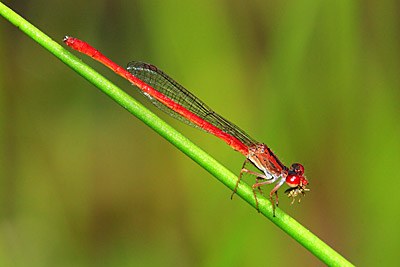
Desert Firetail
Telebasis salva
- Habitat
- Warm-climate ponds and marshes with dense vegetation
- Size
- About 0.9 to 1.1 inches (22-28 mm) long
- Lifespan
- Not well documented for this species specifically; small damselflies of this kind generally fly for a few weeks as adults
- Diet
- Adults catch small flying insects; nymphs feed on aquatic invertebrates
About the Desert Firetail
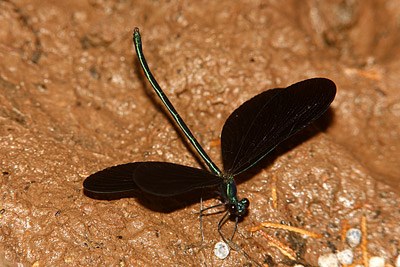
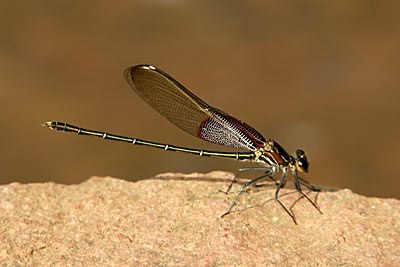
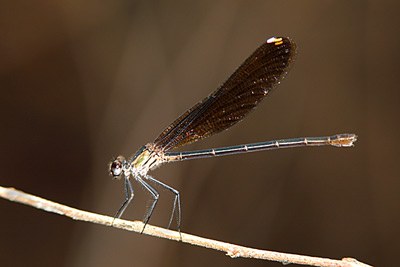
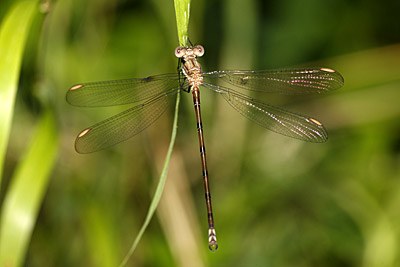
Desert Firetail is a small, warmth-loving damselfly whose range centers on the southern and southwestern United States and Mexico, reaching into the warmer parts of Oklahoma at roughly the northeastern edge of its overall distribution. Its common name reflects both its preference for warmer climates and the fiery red coloring of mature males, a striking departure from the blues and greens typical of most other small damselflies discussed here. It belongs to a small group of American damselflies collectively called firetails, most of which share this same tendency toward red male coloration paired with a fondness for still, plant-choked water.
Mature males show bright red coloring across much of the body, including the abdomen, making them one of the more visually distinctive small damselflies likely to be seen in Oklahoma where the species occurs, since red is an uncommon color among the state's mostly blue, green, or black-and-blue damselflies. Females tend to be duller, often more orange-brown, following the general pattern of subdued female coloring found across many damselfly genera, and can be harder to pick out against dried vegetation than the conspicuous males.
This species favors warm-climate ponds and marshes with dense vegetation, often including mats of duckweed or other floating plants at the water's surface, where adults perch low on plants near the water and make short flights to catch small flying insects such as gnats and midges before returning to a perch. Because of its more southern and southwestern distribution, it is less frequently encountered in Oklahoma than many of the state's other small damselflies, and sightings are more likely in the warmer, southern portions of the state, generally during the hottest stretch of summer when its preferred ponds are at their warmest and most productive.
Breeding follows a pattern broadly similar to other small pond damselflies, with tandem pairs mating and females laying eggs into submerged or emergent plant tissue at the water's edge, the male often continuing to grip the female's thorax while she oviposits as a way of guarding against rival males. Nymphs develop among dense aquatic vegetation, feeding on small aquatic invertebrates as they grow through a series of molts before eventually emerging as winged adults, likely completing development relatively quickly given the warm water temperatures typical of the ponds it favors.
Because of its striking red coloring and more limited distribution within the state, Desert Firetail is a rewarding find for anyone exploring warm, well-vegetated ponds in the southern parts of Oklahoma. Because its range only marginally reaches the state, confirmed Oklahoma records remain relatively few, and any sighting is worth documenting carefully given how much less understood the species' status here remains compared to its core southwestern range; a documented northward creep over time, if it occurs, could also serve as one small data point among many in tracking how warm-adapted species respond to a changing climate.
Beginning observers sometimes mistake a distant Desert Firetail for a small red dragonfly such as a meadowhawk, but the damselfly's slender build, weaker fluttering flight, and habit of folding both pairs of wings together over the back at rest quickly separate it from any of the true dragonflies sharing the same pond. Within its own family, it can be confused with other red-bodied firetails found farther south and west, such as the Duckweed Firetail, though the two are not generally expected to overlap within Oklahoma given how marginally the Desert Firetail's range reaches the state.
Frequently asked questions
What makes the Desert Firetail stand out from other Oklahoma damselflies?
Mature males show bright red coloring, an unusual color among the state's mostly blue, green, or black-and-blue damselflies.
Is the Desert Firetail common throughout Oklahoma?
No, its range centers on the warmer Southwest and Mexico, so sightings in Oklahoma are more likely in the warmer southern parts of the state.
What habitat does the Desert Firetail prefer?
Warm-climate ponds and marshes with dense vegetation, often including floating duckweed mats.
What do Desert Firetails eat?
Adults catch small flying insects like gnats and midges near the water, while nymphs feed on aquatic invertebrates.
Is Desert Firetail related to other 'firetail' damselflies?
Yes, it belongs to a small group of American damselflies called firetails, most of which share the same red male coloration and preference for still, vegetated water.
Where to find it
This species favors wetland habitat. See real Oklahoma locations on the Habitats map.