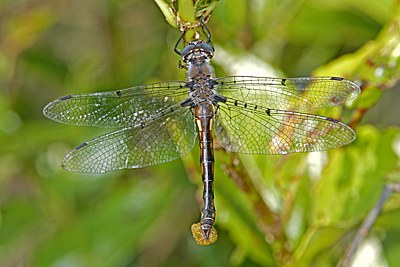
Dot-winged Baskettail
Epitheca petechialis
- Habitat
- Ponds and lakes for breeding; adults are also frequently found well away from water in scrub habitat during their spring flight period.
- Size
- Similar in size to related baskettails, roughly 1.5 to 1.7 inches (about 38-43 mm), though a species-specific figure was not confidently confirmed.
- Lifespan
- Not specifically documented; like other baskettails, adults likely fly for only a few weeks during an early-season window.
- Diet
- Adults catch small flying insects on the wing; nymphs prey on aquatic invertebrates in pond sediment.
About the Dot-winged Baskettail
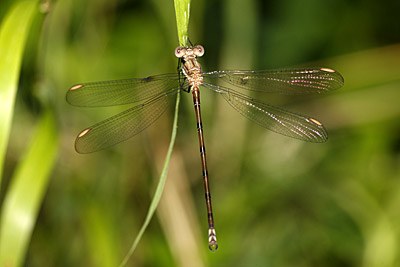
The Dot-winged Baskettail is a brown dragonfly with yellow spots running along the sides of a relatively slender abdomen, closely resembling several other baskettail species found in the same range. Its most useful identifying feature is a distinct row of small brown dots along the leading edge of the hindwing, the detail that gives the species its common name and provides one of the more reliable ways to separate it from its close relatives. Individuals lacking clear dots can be genuinely difficult to distinguish from other baskettails without careful, close examination.
This species breeds in ponds and lakes, but adults are notably often encountered well away from water, and during May and early June it can be one of the more commonly seen dragonflies away from breeding sites, particularly in scrub habitat on slopes away from any nearby water body. Its flight season runs somewhat later than some other baskettails, extending into the warmer months.
Like other members of its genus, the Dot-winged Baskettail is an aerial hunter of small flying insects, and it likely shares the swift, looping hunting-flight style typical of baskettails as a group, though detailed species-specific behavioral studies are limited compared with the very well documented Common Baskettail.
The baskettail name reflects the female's distinctive habit of extruding a basket-shaped mass of eggs at the tip of the abdomen before dipping it into the water, and the resulting nymphs are expected to live as camouflaged predators in pond sediment through an extended larval stage, following the same general pattern seen across the Epitheca genus. Because it can be tricky to separate from its relatives without a good look at the wing pattern, the Dot-winged Baskettail is a good reminder that careful, patient observation, ideally with photographs, pays off when identifying Oklahoma's baskettails. Because reliable identification often depends on close inspection of the hindwing dots, photographing a suspected Dot-winged Baskettail from multiple angles is a worthwhile habit for anyone trying to confirm a sighting rather than relying on memory alone. Its tendency to wander into scrub habitat well away from water also means it can turn up in unexpected places during its short spring flight window.
Frequently asked questions
How do you identify a Dot-winged Baskettail?
Look for a row of small brown dots along the leading edge of the hindwing, though individuals lacking clear dots can be hard to tell from other baskettails.
Where are adults often found away from water?
In scrub habitat, particularly during May and early June, when this species is commonly seen well away from ponds and lakes.
What does it breed in?
Ponds and lakes, following the typical breeding pattern of baskettail dragonflies.
Is this species easy to identify in the field?
Not always; without visible wing dots it closely resembles other baskettail species and can require a close look or photograph to confirm.
Where to find it
This species favors wetland habitat. See real Oklahoma locations on the Habitats map.