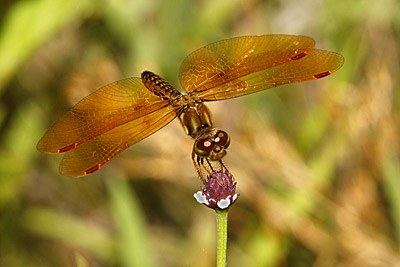
Eastern Amberwing
Perithemis tenera
- Habitat
- Ponds, small lakes, and slow streams with open shoreline, widespread across the eastern and central United States
- Size
- About 0.8 to 1.0 inch (20–25 mm) long, one of the smallest common skimmers
- Lifespan
- Typically a few weeks as a flying adult, in line with other small skimmers, though precise wild figures are not well documented
- Diet
- Adults catch tiny flying insects such as midges and small flies; nymphs prey on small aquatic invertebrates in still water
About the Eastern Amberwing
The Eastern Amberwing is a tiny dragonfly, among the smallest skimmers found in Oklahoma, and mature males are easily recognized by their wings, which are washed with a warm amber-orange color across nearly the entire surface rather than just at the base or tip as in many other species. Females have clearer wings with brown spots instead of the solid amber wash, and both sexes share a brown-and-yellow patterned body considerably smaller and more compact than almost any other skimmer sharing the same pond.
It is a widespread and common species across much of the eastern and central United States, regularly found around ponds, small lakes, and slow streams with open, sunny shoreline, and it often perches on low vegetation, exposed rocks, or bare ground very close to the water's surface rather than up in taller reeds. One of its more entertaining traits is a habit of wing-wagging while perched, rocking its wings up and down in a motion that, combined with its amber coloring and small size, is thought to help it visually mimic a stinging wasp and so deter predators, since it does not have the size or speed advantages larger skimmers use to escape danger.
Adults hunt by making short sallies from a low perch to snatch tiny flying insects such as midges and small flies, a scaled-down version of the perch-and-pursue hunting style typical of skimmers generally, well suited to its small size and modest flight power. The aquatic nymphs live among submerged vegetation and sediment in still water, where they ambush small aquatic invertebrates using the extendable hinged jaw common to all dragonfly larvae, though on a correspondingly smaller scale than the nymphs of larger skimmer species.
Males defend small territories over open water, often quite close to shore, and mate with visiting females; the female then lays eggs by tapping her abdomen against the water's surface, sometimes with the male still attached or hovering nearby. Given its small size and closeness to shore during both hunting and egg-laying, the Eastern Amberwing is often one of the easiest dragonflies for visitors to observe closely at an Oklahoma pond without needing binoculars.
Frequently asked questions
Why does it wave its wings while perched?
This wing-wagging behavior, combined with its wasp-like amber coloring, is thought to help deter predators by making the dragonfly look like a stinging insect.
How small is the Eastern Amberwing compared to other dragonflies?
At under an inch long, it is one of the smallest common skimmers in Oklahoma, noticeably tinier than large species like the Twelve-spotted Skimmer.
Do females have amber wings too?
No, females have clearer wings marked with brown spots rather than the solid amber wash seen in mature males.
Where is a good place to look for one?
Check low perches very close to the water's edge at ponds, small lakes, and slow streams, since it rarely strays far from shore.
Where to find it
This species favors wetland habitat. See real Oklahoma locations on the Habitats map.