Eastern Pondhawk
Erythemis simplicicollis
- Habitat
- Ponds, lakes, and slow-moving waters with floating vegetation.
- Size
- About 1.5 to 1.8 inches (roughly 38-45 mm) long.
- Lifespan
- Not specifically documented; likely several weeks as an adult, typical for medium-sized skimmers.
- Diet
- An aggressive aerial predator that takes damselflies and other insects on the wing, including prey nearly as large as itself, and will cannibalize members of its own species.
About the Eastern Pondhawk
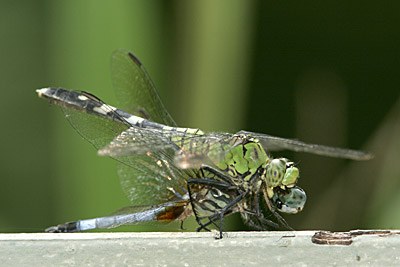
The Eastern Pondhawk shows one of the more striking sex-based color differences among Oklahoma's dragonflies. Females are bright green with a banded abdomen, while mature males develop a powdery blue abdomen paired with a green face and a thorax that mixes green and blue tones. Newly emerged adults of both sexes start out a dull olive green, but within a few hours the abdomen brightens to green, dark brown banding appears, and the head takes on a metallic green sheen; males then continue changing as they mature into their blue adult coloring. Nymphs can be recognized in the water by their green eyes.
This species is a dragonfly of still water, most often found at ponds, lakes, and slow-moving waters associated with floating plants. Its range is broad, covering the Canadian provinces of Ontario and Quebec, much of the eastern United States, and extending south through the Bahamas and the West Indies into Mexico and Central America as far as Costa Rica.
The Eastern Pondhawk is an especially athletic and aggressive predator, capable of catching damselflies and other insects directly out of the air. It readily takes prey nearly as large as itself, and it is not above eating members of its own species, a level of cannibalism that is somewhat unusual even among generally predatory dragonflies. This voracious hunting style makes it one of the more dominant small predators around the still waters it inhabits.
Breeding follows the typical skimmer pattern, with males often perching low near the water to guard territory against rivals before mating, and females laying eggs directly into the water among floating vegetation. The resulting nymphs live as predators of other aquatic invertebrates on the pond bottom before emerging as adults that quickly develop their vivid green or blue coloring within hours of leaving the water. Because males aggressively guard stretches of shoreline and will attack rivals and even other dragonfly species venturing too close, watching a productive pond for a while often reveals repeated aerial skirmishes near the water's edge. Its willingness to tackle large, sometimes similarly sized prey also makes it one of the more effective natural checks on other flying insect populations around the still waters it inhabits.
Frequently asked questions
How do male and female Eastern Pondhawks differ in color?
Females are bright green with a banded abdomen, while mature males develop a powdery blue abdomen with a green face.
Is the Eastern Pondhawk really cannibalistic?
Yes, it will prey on other Eastern Pondhawks in addition to damselflies and other insects, reflecting its generally aggressive hunting style.
What habitat does it prefer?
Ponds, lakes, and slow-moving water with floating vegetation.
How quickly does a newly emerged adult develop its color?
Within a few hours, the dull olive coloring of a fresh adult shifts to bright green with dark banding and a metallic green head.
Where to find it
This species favors wetland habitat. See real Oklahoma locations on the Habitats map.