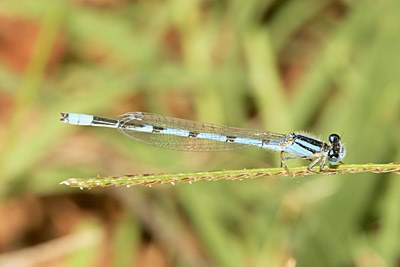
Familiar Bluet
Enallagma civile
- Habitat
- Ponds, lakes, marshes, and slow streams of almost every kind
- Size
- About 1.1 to 1.4 inches (29-35 mm) long
- Lifespan
- Not precisely documented, but adult bluets are generally thought to live several weeks during the flight season
- Diet
- Adults feed on small flying insects; nymphs prey on aquatic invertebrates and small crustaceans
About the Familiar Bluet
Familiar Bluet earns its common name honestly, since it is one of the most widespread and frequently encountered damselflies in North America, found at an enormous range of ponds, lakes, marshes, and slow streams across nearly the entire continental United States, including throughout Oklahoma. For many people, this species is effectively the default small blue damselfly seen at almost any calm body of water.
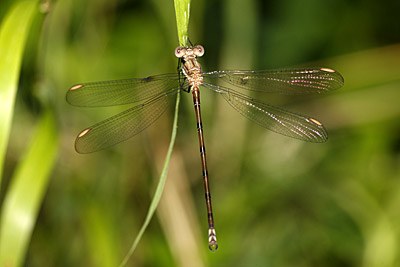
Mature males show the classic bluet pattern: bright blue thorax with black stripes, and an abdomen that alternates blue and black in a banded pattern, with blue concentrated near the base and tip. Females are typically duller blue-green or brownish, a common pattern among female bluets that makes them harder to tell apart from other Enallagma species without careful comparison.
Part of what makes Familiar Bluet so successful and widespread is its tolerance for a very broad range of standing and slow-moving water conditions, from small backyard ponds to large reservoirs, marshes, and roadside ditches, provided there is at least some aquatic or emergent vegetation. Adults are usually seen perched on vegetation at or near the water's edge, making short flights to catch small flying insects such as midges, mosquitoes, and gnats before returning to a nearby perch.
Breeding pairs join in tandem, often with several pairs visible at once around productive water bodies, and females lay eggs into submerged plant tissue, sometimes while still attached to the male and sometimes even briefly submerging to reach suitable plant material below the surface. Nymphs live among aquatic vegetation and debris, preying on small aquatic invertebrates and tiny crustaceans as they grow, before eventually climbing out of the water to emerge as flying adults. Given how common and widely distributed this species is, Familiar Bluet is often the first damselfly a beginning observer in Oklahoma learns to recognize, and it remains a dependable, easy-to-find species at ponds and lakes throughout the warmer months. Because it is so abundant almost everywhere suitable water exists, Familiar Bluet also serves as a convenient baseline species against which the state's many rarer or more habitat-specific bluets and dancers can be compared and learned, and multiple generations may be possible across a long Oklahoma summer given warm enough water temperatures.
Frequently asked questions
Why is it called the Familiar Bluet?
It is one of the most widespread and commonly seen damselflies across North America, making it a familiar sight at almost any pond or lake.
What water does the Familiar Bluet prefer?
It tolerates a very broad range of standing and slow-moving water, from small ponds to large lakes and marshes, as long as some vegetation is present.
How do you recognize a male Familiar Bluet?
Look for a bright blue thorax with black stripes and an abdomen that alternates blue and black, with blue concentrated near the base and tip.
Do female Familiar Bluets look the same as males?
No, females are typically duller, often blue-green or brownish, which is common among female bluets and can make species identification harder.
Where to find it
This species favors wetland habitat. See real Oklahoma locations on the Habitats map.