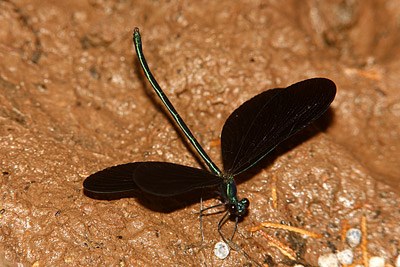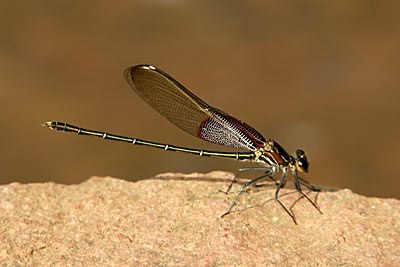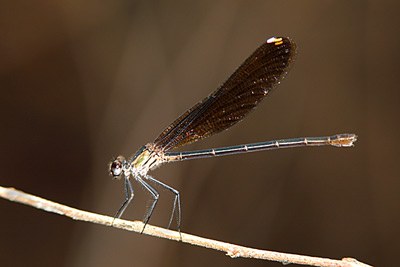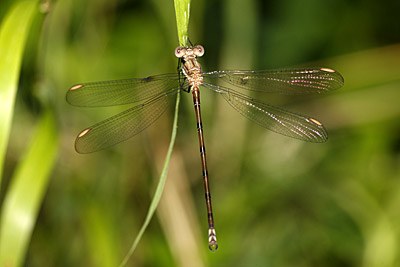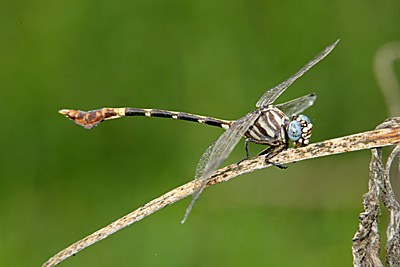
Five-striped Leaftail
Phyllogomphoides albrighti
- Habitat
- Streams and rivers with swift currents and cobble or muddy bottoms, bordered by riparian vegetation.
- Size
- About 2.4 inches (60-63 mm) long.
- Lifespan
- Not specifically documented; likely several weeks as an adult, in line with other leaftails and clubtails.
- Diet
- Adults catch flying insects on the wing; nymphs prey on aquatic invertebrates in river-bottom sediment.
About the Five-striped Leaftail
The Five-striped Leaftail is a large member of the leaftail group, distinguished from its close relative the Four-striped Leaftail by an extra pale stripe across the thorax. Like other leaftails, males carry broad, flattened, leaf-shaped claspers at the tip of the abdomen, used to hold onto the female during mating, a distinctive structural feature that sets the whole group apart from more typical clubtails and gives the genus Phyllogomphoides its name, drawn from Greek roots meaning roughly "leaf-clubtail."
This species favors streams and rivers with swift-flowing current and either cobble or muddy bottoms, usually where riparian vegetation lines the banks. Its confirmed range in the United States is limited to New Mexico and Texas, placing it at the western and southern edge of what a general Oklahoma-focused audience might expect to encounter, though it is included here as part of the broader regional dragonfly fauna relevant to the south-central United States. Like many leaftails, whose greatest diversity lies farther south in Mexico and Central America, this species sits near the northern edge of a genus that is fundamentally more tropical and subtropical in character.
Adults typically perch on vegetation, fences, or similar structures roughly a meter or more above the ground, a habit that keeps them somewhat elevated compared with clubtails that prefer bare ground. Some individuals have also been found perched on grasses several meters from the nearest water, suggesting that, like several other river-breeding dragonflies, this species ranges more widely from its breeding stream than one might expect, likely dispersing to forage in nearby fields before returning to the river to breed.
Males are thought to patrol stretches of river in search of both mates and rival males to challenge, in the manner typical of other swift-water clubtails and leaftails, though detailed observations of this particular species' courtship and territorial behavior remain limited given how little it has been studied compared to more widespread dragonflies. Breeding follows the pattern typical of river-dwelling leaftails: eggs are laid into flowing water, and nymphs settle into cobble or mud substrate on the streambed, where they live as camouflaged, flattened predators of other aquatic invertebrates through an extended larval stage before crawling out to emerge as winged adults.
The species carries a globally secure conservation status, and while it is not commonly reported from the immediate Oklahoma area, it represents the kind of swift-water clubtail relative found across the broader south-central river systems that also support several of Oklahoma's own leaftails and clubtails. Given that its currently confirmed range is limited to New Mexico and Texas, it stands as one of the more range-restricted entries on this list rather than a species expected regularly farther north or east.
Because Phyllogomphoides as a genus reaches its greatest diversity in the lowland tropics of Mexico and Central America, the handful of species reaching the southern United States, including this one, effectively represent the northernmost outposts of a much larger tropical radiation, similar to the pattern seen in several other insect groups whose center of diversity lies well south of the U.S. border. This tropical affinity likely also explains why the species appears restricted to the warmest available river habitat within its limited U.S. range, rather than spreading into cooler upland streams the way some more temperate-adapted clubtails do. Observers hoping to find one should focus search efforts on warm, swift rivers during the warmest part of the flight season, checking streamside vegetation and fence lines well back from the immediate bank rather than only scanning the water's edge.
Frequently asked questions
How do you tell a Five-striped Leaftail from a Four-striped Leaftail?
By counting the pale stripes on the thorax: five for this species versus four for its close relative.
What is the purpose of the leaf-shaped structures at the tip of the male's abdomen?
They are claspers used to hold onto the female during mating, the feature that gives all leaftails their common name.
What kind of water does it need?
Swift-flowing streams and rivers with cobble or muddy bottoms and riparian vegetation along the banks.
Where is it mainly found in the United States?
Its confirmed U.S. range is limited to New Mexico and Texas.
Where does the genus name Phyllogomphoides come from?
It derives from Greek roots meaning roughly 'leaf-clubtail,' a reference to the broad, flattened, leaf-shaped claspers males use to grip females during mating.
Where to find it
This species favors wetland habitat. See real Oklahoma locations on the Habitats map.