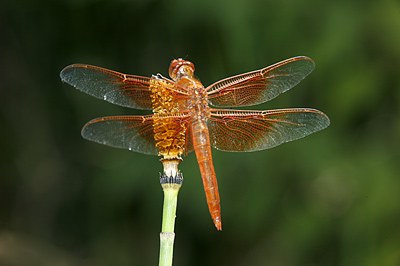
Flame Skimmer
Libellula saturata
- Habitat
- Ponds, slow streams, and quiet river backwaters, mainly in the western and southwestern United States
- Size
- About 2.0 to 2.2 inches (50–56 mm) long
- Lifespan
- Probably several weeks as a flying adult, similar to related skimmers, though exact figures for this species are not well documented
- Diet
- Adults hawk flying insects such as mosquitoes, flies, and small moths; nymphs feed on aquatic insect larvae and other small invertebrates
About the Flame Skimmer
The Flame Skimmer is named for the fiery orange-red color that spreads across the mature male's entire body and extends into the wing veins, giving the insect a warm, glowing look reminiscent of its close relative, the Neon Skimmer. The two species can be difficult to separate at a glance, though the Flame Skimmer tends to show a slightly more amber-orange tone overall, and their ranges differ, with the Flame Skimmer being the more widespread species across the drier West and Southwest, only reaching Oklahoma toward the western edge of its range. Females and immature males are duller brown-orange with pale side stripes on the thorax, gradually developing the fuller orange coloring as they age.
This species favors ponds, slow-moving streams, and quiet backwaters along larger rivers, often in open, sunny settings typical of the arid and semi-arid landscapes where it is most common. In Oklahoma, it is more likely to be found in the western part of the state, where habitat and climate more closely resemble the drier conditions it favors farther west. Males perch prominently on exposed twigs, rocks, or bare ground near water, from which they launch short territorial and hunting flights.
Adults hunt by sallying from a perch to intercept flying insects such as mosquitoes, flies, and small moths, using bristled legs to trap prey in mid-air before returning to a perch to feed, a hunting style shared by most skimmers. Nymphs are entirely aquatic and live among submerged vegetation, sediment, or debris, where they ambush mosquito larvae and other small aquatic invertebrates using a fast-extending hinged jaw.
Breeding follows the typical skimmer pattern: males hold territory over a stretch of water, mate with visiting females, and the female then lays eggs by tapping her abdomen against the water's surface, often while the male hovers nearby to guard against competing males. Eggs hatch into nymphs that develop underwater, likely over the course of a year or so depending on conditions, before finally emerging onto a plant stem or rock to complete the molt into the vivid orange-red adult.
Frequently asked questions
How is the Flame Skimmer different from the Neon Skimmer?
Both are brilliant orange-red skimmers, but the Flame Skimmer tends to be slightly more amber-toned and is generally the more common of the two farther west, while the Neon Skimmer is more southern and southwestern.
Where would I find one in Oklahoma?
It is more typical of the drier western part of the state, near ponds, slow streams, or quiet river backwaters.
What color are females?
Females and young males are duller brown-orange with pale stripes on the thorax, developing fuller orange coloring as they mature.
What does it eat?
Adults catch small flying insects like mosquitoes and moths in the air, while nymphs prey on aquatic insect larvae underwater.
Where to find it
This species favors wetland habitat. See real Oklahoma locations on the Habitats map.