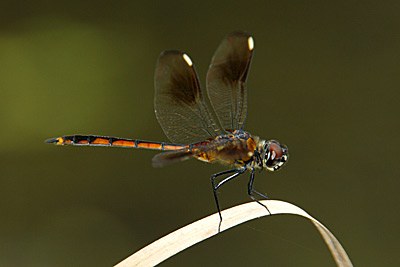
Four-spotted Pennant
Brachymesia gravida
- Habitat
- Lakes, large coastal marshes, drainage canals, and artificial lakes; tolerant of alkaline and slightly brackish water.
- Size
- A medium-sized skimmer, typically in the range of about 1.7 to 2 inches (roughly 45-50 mm), consistent with other pennant dragonflies.
- Lifespan
- Not specifically documented; likely several weeks as an adult, similar to other pennant skimmers.
- Diet
- Adults catch flying insects near open water; nymphs prey on aquatic invertebrates, tolerating somewhat saline or alkaline conditions.
About the Four-spotted Pennant
The Four-spotted Pennant is identified by the four brown spots on its wings, one near the base of each wing and one closer to the tip, along with a white pterostigma on each wing that stands out clearly against the surrounding wing membrane. Immature individuals and females have a brown thorax, while mature males develop a blue coloration overall. The face is black and white, with the white portions darkening as the dragonfly ages, and the legs are black throughout.
This species favors open lakes, often ones that support relatively few other dragonfly species, along with large coastal marshes in Texas, drainage canals, and artificial lakes. Notably, it tolerates alkaline water conditions and can even persist in slightly brackish water, an adaptability that lets it occupy habitats many other freshwater dragonflies avoid. It occurs across a broad swath of the southern and eastern United States, including Oklahoma, and reaches into north-central and northeastern Mexico. Flight season in Oklahoma generally runs from late spring through the warmer months of summer, with adults most conspicuous around open water on hot, sunny days.
Adults hunt flying insects over open water and along shorelines, in the manner typical of pennant skimmers, using elevated perches on emergent vegetation or shoreline structures to watch for both prey and rival males. On especially hot days, like many open-water skimmers, individuals may raise the abdomen toward the sun in an obelisk posture, minimizing the body surface exposed to direct sunlight as a simple way of avoiding overheating. Its tolerance for marginal water chemistry means it can turn up at sites, including some coastal and man-made water bodies, that would otherwise support a fairly limited dragonfly community.
Males defend territories over open water, chasing off rival males and courting passing females with brief pursuit flights, a pattern broadly typical of skimmers breeding at large, open bodies of water rather than small, vegetated ponds. Breeding follows the general skimmer pattern, with females laying eggs directly into open water and the nymphs developing among sediment and vegetation on the lake or marsh bottom, tolerating whatever degree of salinity or alkalinity the particular water body presents, before emerging as winged adults.
This adaptability to less-than-ideal freshwater conditions is one of the more distinctive aspects of the Four-spotted Pennant's natural history, setting it apart from more habitat-sensitive dragonflies in the same region. Because it tolerates alkaline, brackish, and otherwise marginal water so well, this species is sometimes one of relatively few dragonflies present at man-made lakes and drainage canals that support little other aquatic life. That tolerance, combined with its wide range across the southern United States and into Mexico, makes it one of the more adaptable and widely distributed pennants an Oklahoma observer is likely to encounter.
Like several other pennant and glider dragonflies adapted to marginal or temporary water bodies, the Four-spotted Pennant appears to be a capable disperser, readily colonizing new man-made lakes, drainage canals, and farm ponds soon after they are built, a trait that likely helps explain its wide and somewhat patchy distribution across the southern United States. This willingness to exploit new or unstable water bodies sets it apart from more habitat-conservative dragonflies that depend on long-established, naturally vegetated ponds, and makes the Four-spotted Pennant one of the more reliable species to check for at a freshly dug or recently filled pond in warmer parts of Oklahoma.
Frequently asked questions
How can you recognize a Four-spotted Pennant?
Look for four brown spots on the wings and a bright white pterostigma, with mature males showing blue coloration overall.
What makes this species unusual among dragonflies?
It tolerates alkaline and even slightly brackish water, letting it occupy habitats many freshwater dragonflies avoid.
Where is it typically found?
Open lakes, large coastal marshes in Texas, drainage canals, and artificial lakes across the southern and eastern United States.
Does its range extend beyond the United States?
Yes, it also occurs in north-central and northeastern Mexico.
How does the Four-spotted Pennant cope with intense summer heat?
Like many open-water skimmers, it may point its abdomen toward the sun in an 'obelisk' posture to reduce the body surface exposed to direct sunlight.
Where to find it
This species favors wetland habitat. See real Oklahoma locations on the Habitats map.