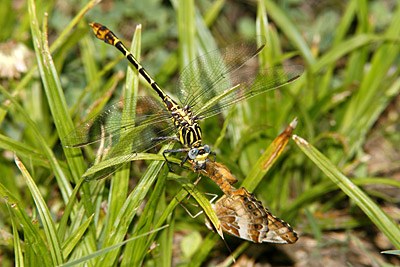
Four-striped Leaftail
Phyllogomphoides stigmatus
- Habitat
- Rivers with flowing water in Texas and Mexico; adults often perch on streamside vegetation away from the water's edge.
- Size
- A large clubtail-relative, roughly 2.3 to 2.5 inches (about 60 mm) long, consistent with other leaftails.
- Lifespan
- Not specifically documented; likely several weeks as an adult, similar to other gomphid dragonflies.
- Diet
- Adults catch flying insects on the wing; nymphs prey on aquatic invertebrates in river-bottom sediment.
About the Four-striped Leaftail
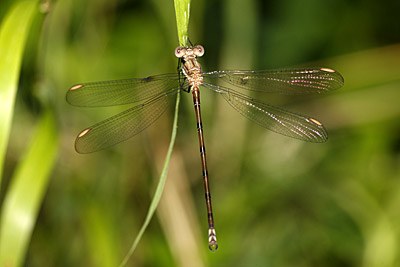
The Four-striped Leaftail belongs to a small group of clubtail relatives called leaftails, named for the broad, flattened, leaf-shaped appendages at the tip of the male's abdomen, used for grasping the female during mating. This species shows a greenish-yellow body marked with black patterning and, as its common name indicates, four pale stripes along the thorax, a feature used to help separate it from the closely related Five-striped Leaftail found in overlapping territory.
Its range centers on Texas and Mexico, where it breeds in flowing rivers. Records place the species as far south as Coahuila, Mexico, and it reaches into the southern edge of the region covered by this guide. Leaftails as a group tend to be somewhat local and are more often encountered in the warmer, southern portions of Oklahoma and neighboring Texas than farther north.
Adults are known for perching away from open water, often settling on streamside vegetation, fences, or other structures at some height above the ground rather than right at the shoreline, a habit that can make them easy to overlook even when present at a river system. When hunting, they sally out to catch flying insects and return to a favored perch, in the manner typical of clubtails and their relatives.
Breeding follows the pattern expected of river-dwelling gomphids: females lay eggs into flowing water, and the nymphs, like those of other leaftails, are flattened, camouflaged ambush predators adapted to life on the river bottom, where they spend an extended larval period before emerging as adults. The distinctive leaf-shaped claspers used in mating give this group of dragonflies their name and are one of the more visually interesting structural details among Oklahoma's clubtail relatives, worth a close look through binoculars or a photograph when one is found perched. The flattened, camouflaged nymphs typical of leaftails are well adapted to blend into river-bottom sediment, ambushing invertebrates that pass within reach rather than actively chasing them down. Because leaftails as a group are more often reported from the warmer southern reaches of Texas and Mexico, any confirmed Oklahoma sighting is worth documenting carefully and reporting to regional dragonfly recorders.
Frequently asked questions
Where does the name 'leaftail' come from?
It refers to the broad, flattened, leaf-shaped appendages at the tip of the male's abdomen, used to grasp the female during mating.
How is the Four-striped Leaftail told apart from the Five-striped Leaftail?
By counting the pale stripes on the thorax, four versus five, since the two species overlap in range and look similar otherwise.
Where is this species typically found?
Along rivers in Texas and Mexico, reaching into the warmer southern parts of the wider Oklahoma-Texas region.
Do adults stay close to the water?
Not always; they often perch on vegetation or structures well above the ground, sometimes away from the immediate shoreline.
Where to find it
This species favors wetland habitat. See real Oklahoma locations on the Habitats map.