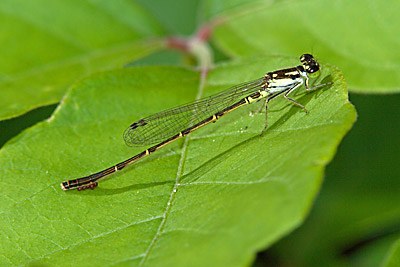
Fragile Forktail
Ischnura posita
- Habitat
- Small, often shaded ponds, ditches, and seepage areas with minimal vegetation
- Size
- About 0.8 to 1.1 inches (21-27 mm) long
- Lifespan
- Not well documented for this species specifically; small forktails generally fly for a few weeks as adults
- Diet
- Adults catch tiny flying insects; nymphs feed on small aquatic invertebrates
About the Fragile Forktail
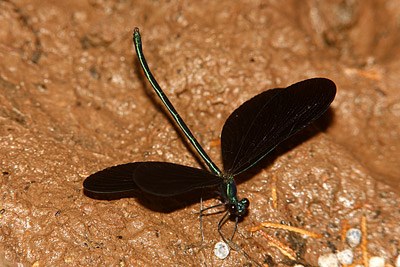
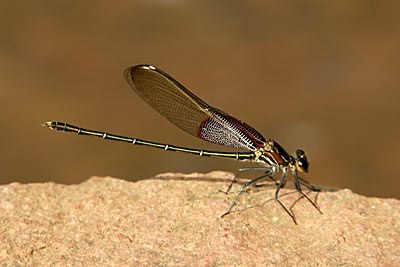
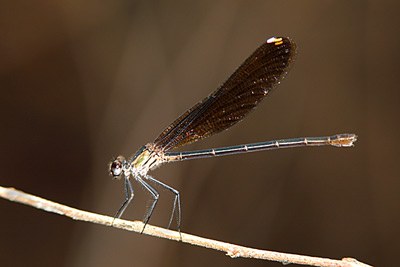
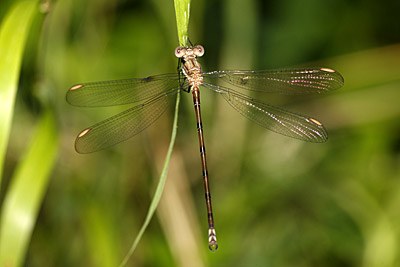
Fragile Forktail is a small, delicate-looking damselfly best known for a distinctive thoracic marking: pale, broken green shoulder stripes on an otherwise black thorax that together resemble a pair of small, sideways exclamation points, a pattern unlike the longer, unbroken stripes typical of many other damselflies. This exclamation-mark pattern is one of the more reliable and often-cited field marks in the whole damselfly group, since it is fairly easy to see even on a small, fast-moving insect.
Males have a mostly black thorax and abdomen with pale green sides, while females, as in many forktails, become increasingly pruinose and blue-gray with age, which can obscure the shoulder-stripe pattern that makes males so recognizable and sometimes requires a closer look to confirm identification.
This species has a notably broad tolerance for small, marginal, and even disturbed water bodies, including shaded ponds, roadside ditches, seepage areas, and other modest wet spots that many other damselflies would ignore. This flexibility helps make Fragile Forktail one of the more widely distributed and commonly encountered forktails, since it does not require large, pristine water bodies to complete its life cycle.
Adults hunt tiny flying insects near their preferred small water bodies, making short flights from low perches on grasses or other vegetation before returning to rest. Breeding follows the typical forktail and bluet pattern, with tandem pairs mating and females laying eggs into submerged or emergent plant tissue at the water's edge. Nymphs develop in the shallow, often modest water bodies favored by adults, feeding on small aquatic invertebrates as they grow through a series of molts before eventually emerging as flying adults. Because it tolerates such a wide range of small and sometimes marginal wet habitats, Fragile Forktail is one of the damselflies most likely to turn up even in unremarkable, human-altered settings around Oklahoma, from farm ponds to drainage ditches. As with other forktails, mated pairs remain joined in tandem while the female lays her eggs, the male continuing to grip her to guard against rival males. Because it turns up in so many small, easily accessible wet spots, from farm-pond edges to roadside ditches, Fragile Forktail is often one of the easier damselflies for beginning observers in Oklahoma to find close to home.
Frequently asked questions
What is the exclamation mark on a Fragile Forktail?
It refers to pale, broken green shoulder stripes on the thorax that together resemble a small sideways exclamation point, a key field mark for males.
Does the Fragile Forktail need pristine habitat?
No, it tolerates a wide range of small and even disturbed water bodies, including roadside ditches and shaded farm ponds.
Do male and female Fragile Forktails look the same?
No, females become increasingly pruinose and blue-gray with age, which can obscure the shoulder-stripe pattern seen clearly on males.
What does the Fragile Forktail eat?
Adults catch tiny flying insects near the small ponds and ditches they inhabit, while nymphs feed on small aquatic invertebrates.
Where to find it
This species favors wetland habitat. See real Oklahoma locations on the Habitats map.