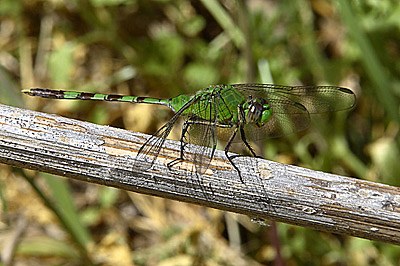
Great Pondhawk
Erythemis vesiculosa
- Habitat
- Ponds, lakes, ditches, and slow-moving creeks, streams, and rivers, often among floating plants such as water lilies, lotus, and duckweed.
- Size
- Larger than the closely related Eastern Pondhawk, with a more slender abdomen; a precise measurement was not confidently confirmed, though a range of roughly 2 to 2.2 inches (50-55 mm) is a reasonable estimate based on its relative size.
- Lifespan
- Not specifically documented; likely several weeks as an adult, similar to other large pondhawks.
- Diet
- Adults prey on other flying insects, including other dragonflies; nymphs feed on aquatic invertebrates among floating vegetation and pond sediment.
About the Great Pondhawk
The Great Pondhawk is the larger cousin of the familiar Eastern Pondhawk, distinguished by its more slender abdomen and a set of dark rings across abdominal segments four through seven. Its eyes are widely joined along the top of the head, a feature shared with many skimmers but useful for confirming identification alongside its green overall coloring and larger size relative to the Eastern Pondhawk.
This species occupies a wide range of still and slow-moving water habitats, including ponds, lakes, ditches, and slow creeks, streams, and rivers. It shows a particular fondness for water surfaces covered in floating vegetation such as water lilies, lotus, and duckweed, where males establish and patrol territories. Distributed throughout much of the Americas, the Great Pondhawk reaches as far north as the southern United States, including southern Texas and Oklahoma, at the northern edge of its overall range.
Like its smaller relative, the Great Pondhawk is an assertive aerial predator, taking other flying insects on the wing, including other dragonflies, a habit that places it near the top of the insect food chain in the still waters it patrols. Its larger size likely allows it to tackle somewhat bigger prey than the Eastern Pondhawk typically manages.
Males patrol their chosen stretch of floating vegetation to defend territory and attract mates, a behavior pattern common among skimmers that breed at vegetated still water. Breeding itself follows the usual pattern, with females laying eggs directly into the water near the floating plants, and the nymphs developing among that same vegetation and the sediment beneath it, preying on other aquatic invertebrates through an extended larval stage before emerging as adults. Because it sits at the northern edge of its range in Oklahoma, the Great Pondhawk is a notable, somewhat southern-flavored addition to the state's dragonfly fauna, worth watching for at lily-covered ponds and quiet backwaters. Because it favors dense floating vegetation like lily pads and duckweed mats, a Great Pondhawk sighting often comes while watching a quiet, plant-choked corner of a pond rather than open water. Reaching only the northern edge of its range in Oklahoma and Texas, it is best treated as a special, somewhat southern find rather than a dragonfly expected at every local pond.
Frequently asked questions
How does the Great Pondhawk differ from the Eastern Pondhawk?
It is larger, with a more slender abdomen and dark rings on abdominal segments four through seven.
What kind of water does it favor?
Ponds, lakes, ditches, and slow creeks, streams, and rivers, especially where floating plants like water lilies or duckweed cover the surface.
How aggressive a predator is the Great Pondhawk?
Very; it readily takes other flying insects, including other dragonflies, on the wing.
Is Oklahoma near the edge of this species' range?
Yes, the Great Pondhawk is distributed through much of the Americas and reaches only the northern edge of its range in states like Oklahoma and Texas.
Where to find it
This species favors wetland habitat. See real Oklahoma locations on the Habitats map.