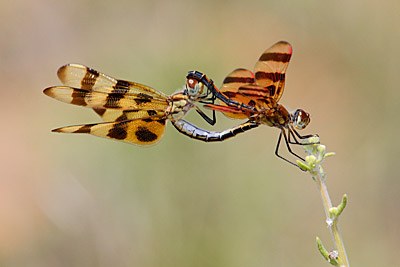
Halloween Pennant
Celithemis eponina
- Habitat
- Ponds and lakes with emergent vegetation and tall grasses along the margins.
- Size
- About 38 to 42 mm long (roughly 1.5 to 1.7 inches), the largest species in its genus.
- Lifespan
- Not specifically documented; likely a few weeks as an adult, consistent with related pennant skimmers.
- Diet
- Adults catch flying insects on the wing near breeding waters and adjacent grassy areas.
About the Halloween Pennant
The Halloween Pennant earns its festive common name from its wings, which are translucent orange-yellow overall and marked with dark brown bands, a combination reminiscent of the October holiday's traditional colors. It is the largest species in its genus, and young individuals show yellow markings, including a stripe along the back, while adults of both sexes may develop pale reddish tones, especially on the face, as they mature.
This dragonfly breeds at ponds and lakes with emergent vegetation, which it relies on heavily both for perching and as safe egg-laying sites, and it is particularly drawn to areas with tall grasses that offer similar perching opportunities. Its native range covers eastern North America along with the West Indies, and in northern parts of that range it is typically seen from mid-June to mid-August, with a somewhat longer season likely in warmer areas such as Oklahoma.
Halloween Pennants have a distinctive perching style, favoring the very tips of tall grasses, wooden posts, and the tops of bushes or small trees, often selecting bare twigs rather than leafy branches. Rather than holding the wings flat as many dragonflies do, this species angles them slightly forward, and it frequently adopts a tail-up, wings-out obelisk posture that reduces the amount of direct sun hitting the body, a useful behavior during the heat of the day. Adults tend to return repeatedly to the same favored perch after short hunting flights, making them relatively easy to watch once a good perch is located.
Breeding follows the typical skimmer pattern, with females laying eggs into the water near the emergent vegetation favored by the adults, and the nymphs develop among submerged plant stems, preying on other small aquatic invertebrates through their larval stage before emerging as winged adults. The combination of bold, butterfly-like wing coloring and habitual perching makes the Halloween Pennant one of the more visually striking and easily observed dragonflies at Oklahoma ponds in summer. Its bold orange-and-brown wing pattern has sometimes been compared to that of a monarch butterfly, and some observers have speculated this resemblance might offer a degree of protection from predators that avoid the chemically distasteful butterfly, though this idea remains more of an interesting hypothesis than a confirmed fact. Regardless of the reason behind its coloring, the pattern makes this species one of the most recognizable pennants at Oklahoma ponds in midsummer.
Frequently asked questions
Why is it called the Halloween Pennant?
Its orange-yellow wings marked with dark brown bands resemble the traditional colors of the October holiday.
What is the 'obelisk' posture some pennants use?
A tail-up position with the wings held out, which reduces the amount of direct sunlight hitting the body during hot weather.
Where does the Halloween Pennant like to perch?
On the tips of tall grasses, wooden posts, and bare twigs at the top of bushes or small trees.
What habitat does it need for breeding?
Ponds and lakes with emergent vegetation and tall grassy margins.
Where to find it
This species favors wetland habitat. See real Oklahoma locations on the Habitats map.