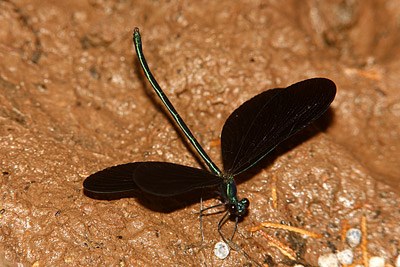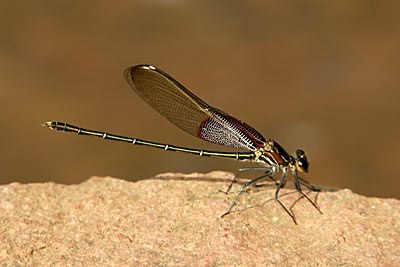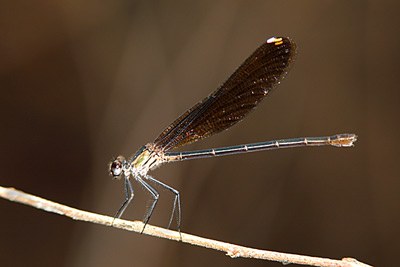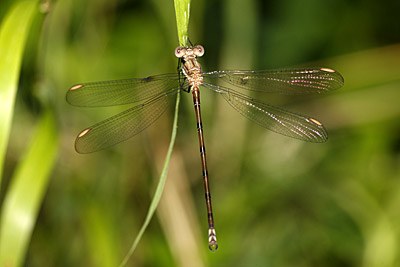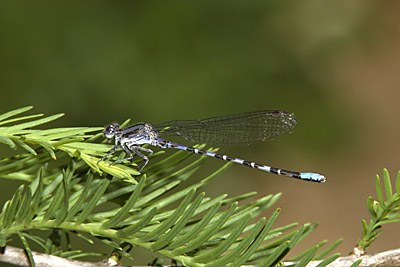
Kiowa Dancer
Argia immunda
- Habitat
- Streams, spring runs, and pools in warmer, often southern or southwestern settings
- Size
- About 1.0 to 1.2 inches (27-33 mm) long
- Lifespan
- Species-specific lifespan data has not been well documented; dancers generally fly for a few weeks as adults
- Diet
- Adults take small flying insects near the water; nymphs prey on aquatic invertebrates
About the Kiowa Dancer
Kiowa Dancer is a damselfly of warmer stream systems, more characteristic of the southern Great Plains and Southwest than of the cooler, more heavily wooded creeks of the eastern United States. In Oklahoma it reaches roughly the eastern or northern edge of a range that extends south into Texas and Mexico, making it one of the more southwestern-flavored dancers on the state's species list. It belongs to the genus Argia, one of the largest damselfly genera in North America, a diverse group whose many species overlap broadly in size, habitat, and general blue or violet coloring, which is exactly why field identification within the genus so often comes down to fine anatomical detail rather than a quick glance.
Mature males show the blue-to-violet coloration typical of many Argia dancers, paired with the genus's usual pattern of a striped thorax and a slim, mostly dark abdomen; distinguishing it from closely related blue and violet dancers in the field generally requires attention to fine details of the male's abdominal appendages, since general coloration alone overlaps considerably among species in this genus. Females tend to be less vividly colored than males, following the pattern typical of most dancers, and are correspondingly even harder to identify to species without close examination.
This species is generally found along streams, spring-fed runs, and pools in warmer regions, often in more open, sun-exposed stretches rather than deeply shaded forest creeks. Adults perch low near the water, on rocks, gravel, or bank vegetation, sallying out to catch small flying insects and returning to the same general area to feed, rest, and watch for mates or rivals. Flight season in Oklahoma likely runs through the warmer months, tracking the availability of its preferred warm-water stream habitat.
As with other dancers, reproduction involves a tandem mating pair, with the male continuing to grasp the female while she deposits eggs into submerged plant material or other suitable substrate at the water's edge. The resulting nymphs live in the stream, sheltering among gravel, debris, and vegetation while feeding on smaller aquatic invertebrates as they develop toward emergence.
Because it sits toward the edge of its known range in Oklahoma, Kiowa Dancer is less commonly recorded than some of the state's more widespread dancers, and sightings tend to be concentrated in the warmer stream systems of the southern and western parts of the state. Because records from Oklahoma likely represent only a partial picture of where the species actually occurs, additional surveying in warmer southern counties could turn up populations not yet formally recorded.
Argia dancers as a group are named for their quick, darting flight and habit of perching with wings folded rather than held open, behavior that gives the genus its common name and separates dancers at a glance from the more open-winged spreadwings and the closed-but-different posture of pond damsels like the bluets and forktails. Kiowa Dancer shares this general dancer behavior, favoring low perches within easy reach of the water and short, quick sallies after prey rather than long sustained flights. Because so many Argia species look broadly similar and often occur together at the same stream, careful observers photographing a suspected Kiowa Dancer are usually well served by trying to capture a clear side view of the male's terminal appendages, since that detail, more than color, is what separates a confirmed record from an educated guess.
Frequently asked questions
Is the Kiowa Dancer common throughout Oklahoma?
No, it is more typical of warmer southern and southwestern stream systems and is less commonly recorded than widespread species like the Blue-fronted Dancer.
How can you distinguish a Kiowa Dancer from other blue or violet dancers?
Reliable identification usually depends on close examination of the male's abdominal appendages rather than overall color, since coloration overlaps among related species.
What habitat does the Kiowa Dancer prefer?
It favors streams, spring runs, and pools in warmer, often more open and sun-exposed settings.
What do Kiowa Dancer nymphs eat?
They feed on small aquatic invertebrates while living among stream gravel, debris, and vegetation.
How many kinds of dancer damselflies (Argia) are there?
Argia is one of the largest damselfly genera in North America, with dozens of species that overlap broadly in color and habitat, which is why close examination is often needed to tell them apart.
Where to find it
This species favors wetland habitat. See real Oklahoma locations on the Habitats map.