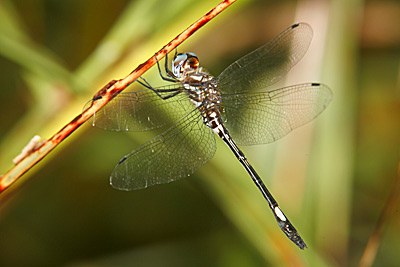
Pale-faced Clubskimmer
Brechmorhoga mendax
- Habitat
- Rivers and streams with flowing water, particularly in the southwestern United States, including rocky streams in Arizona and comparable habitats farther east.
- Size
- About 2 to 2.5 inches (52-64 mm) long.
- Lifespan
- Not specifically documented; likely several weeks as an adult, consistent with other large skimmers.
- Diet
- Adults catch flying insects during long patrol flights over stream riffles; nymphs prey on aquatic invertebrates in flowing water.
About the Pale-faced Clubskimmer
The Pale-faced Clubskimmer is named for the noticeably pale face that contrasts with its darker body, a straightforward field mark once the dragonfly is seen well. It is a fairly large skimmer, reaching roughly two to two and a half inches in length, and it behaves in some ways more like a river cruiser than a typical pond-dwelling skimmer, an example of how similar hunting styles can evolve independently in unrelated dragonfly groups that share a swift-water lifestyle.
This species is closely tied to flowing water, favoring rivers and streams rather than still ponds or lakes. It is well documented in the southwestern United States, with sightings along Arizona waterways such as the Salt River, Agua Fria River, and Sonoita Creek, and it also occurs farther east across parts of its range that reach into rocky, spring-fed streams in states including Oklahoma, particularly in areas with clear, moving water and stony or gravel substrate. Flight season generally spans the warmer months, with adults most active during summer when stream flows and insect activity are both at their peak.
Rather than perching frequently, adults are known for long, continuous flights back and forth over stream riffles, patrolling stretches of moving water for extended periods while hunting flying insects on the wing, a behavior pattern that closely parallels the river cruisers despite the two groups not being closely related. This tireless patrol flight can make the species harder to photograph well than a dragonfly that perches regularly, since a clear view usually depends on catching it during a brief pause; males patrolling a productive riffle will also intercept and chase off rival males entering the same stretch, then resume their beat.
Mating is thought to occur near these patrolled riffles, after which females lay eggs into the current, tapping the abdomen against the water's surface in flight rather than landing, a common oviposition style among fast-flying river skimmers. The nymphs develop among gravel, rocks, or sediment on the streambed, feeding on other aquatic invertebrates through an extended larval period before emerging as adults along the bank.
Because it depends on clean, flowing streams rather than degraded or stagnant water, the Pale-faced Clubskimmer's presence at a site is a reasonably good sign of decent water quality and habitat condition. Because it favors flowing water in the Southwest and adjacent regions, Oklahoma sightings are more likely along clear, rocky streams in the eastern part of the state than at typical farm ponds. Watching a favored riffle for an extended stretch of time, rather than searching the immediate shoreline, is usually the most productive way to spot this near-constantly flying species.
The genus Brechmorhoga, to which the Pale-faced Clubskimmer belongs, includes a handful of similarly swift-water-adapted species distributed from the southwestern United States south through Mexico and Central America, most sharing the same tendency toward long, tireless patrol flights over riffles rather than perched, sit-and-wait hunting. This hunting style likely reflects the demands of feeding over fast, turbulent water, where a fixed perch may offer fewer easy opportunities to intercept passing insects than a continuously moving search path. Nymphs are believed to develop among gravel and cobble in the same riffles adults patrol as flying insects, though detailed studies of the immature stage remain limited compared to work done on more thoroughly studied pond-dwelling skimmers.
Frequently asked questions
What does the name 'Pale-faced Clubskimmer' refer to?
Its noticeably pale face, which contrasts with the rest of its darker body.
How does its flight behavior stand out?
It flies back and forth over stream riffles for long stretches rather than perching often, a habit similar to unrelated river cruisers.
Where is it most commonly documented?
In the southwestern United States, including Arizona rivers and streams, with records extending into rocky streams farther east.
What does its presence suggest about a stream?
Since it depends on clean, flowing water, finding this species is a decent sign of good stream water quality.
Why is the Pale-faced Clubskimmer often compared to river cruisers?
It shares the river cruisers' habit of long, continuous patrol flights back and forth over riffles rather than perching often, even though the two groups are not closely related.
Where to find it
This species favors wetland habitat. See real Oklahoma locations on the Habitats map.