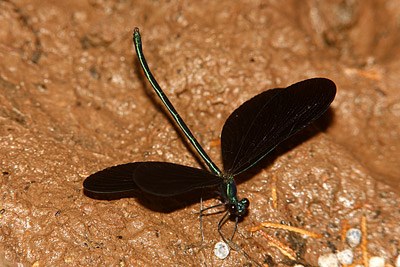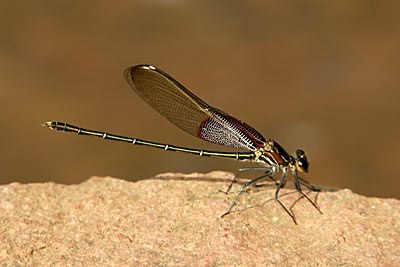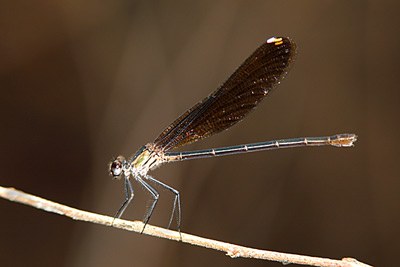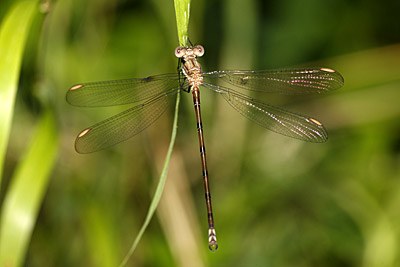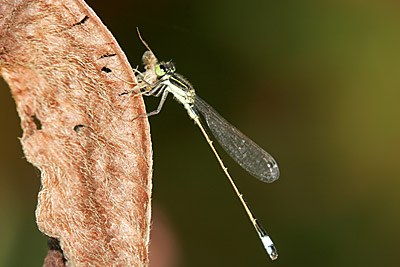
Rambur's Forktail
Ischnura ramburii
- Habitat
- A wide variety of ponds, marshes, and slow streams, including brackish coastal waters elsewhere in its range
- Size
- About 1.1 to 1.4 inches (27-35 mm) long
- Lifespan
- Not well documented for this species specifically; forktails generally fly for a few weeks as adults
- Diet
- Adults catch small flying insects; nymphs feed on aquatic invertebrates
About the Rambur's Forktail
Rambur's Forktail is a widespread and adaptable damselfly found across a broad swath of the southern and central United States, including Oklahoma, and known for tolerating an unusually wide range of water conditions. In much of its range, including coastal areas well outside Oklahoma, it is notable for being one of the few North American damselflies able to breed successfully in brackish, slightly salty water, a tolerance that helps explain its broad overall distribution even though inland Oklahoma populations use ordinary fresh water.
Mature males show blue-green thorax coloring with a mostly black abdomen tipped in blue, following the general pattern of the genus Ischnura. Females, however, are notably polymorphic, meaning individual females can show different color forms; some resemble males with blue-green tones, called andromorphs, while others show orange or brownish coloring instead, a variation that can make female identification considerably trickier than identifying males.
Adults are generalists in terms of habitat, found around ponds, marshes, and slow streams with at least some vegetation, where they hunt small flying insects by making short sallying flights from low perches before returning to rest. This habitat flexibility, combined with tolerance for varied water chemistry, likely contributes to the species' wide distribution across much of the warmer parts of North America.
Breeding follows the tandem-pair pattern typical of forktails, with females laying eggs into submerged or emergent plant tissue near the water's edge. Nymphs develop in the water among vegetation and debris, feeding on small aquatic invertebrates as they grow through a series of molts before eventually emerging as winged adults. Because of its broad habitat tolerance, Rambur's Forktail is one of the more adaptable damselflies likely to be found across a wide range of pond, marsh, and slow-stream settings in Oklahoma, not limited to any single narrow habitat type. As with other forktails, mated pairs remain joined in tandem, the male continuing to grip the female while she lays eggs into plant tissue at the water's edge. Because it tolerates such a broad range of conditions, from ordinary farm ponds to marshes and slow streams, Rambur's Forktail is one of the damselflies most likely to be encountered across a wide variety of Oklahoma wetland habitats rather than being tied to any single specialized setting.
Frequently asked questions
What is unusual about Rambur's Forktail's habitat tolerance?
In parts of its range it can breed in brackish, slightly salty water, a tolerance shared by very few other North American damselflies, though inland Oklahoma populations use fresh water.
Why are female Rambur's Forktails hard to identify?
Females are polymorphic, appearing in different color forms, some resembling males in blue-green tones and others showing orange or brownish coloring.
What habitats does Rambur's Forktail use in Oklahoma?
Ponds, marshes, and slow streams with at least some vegetation, reflecting its generally flexible habitat preferences.
What do Rambur's Forktails eat?
Adults catch small flying insects near the water, while nymphs feed on aquatic invertebrates.
Where to find it
This species favors wetland habitat. See real Oklahoma locations on the Habitats map.