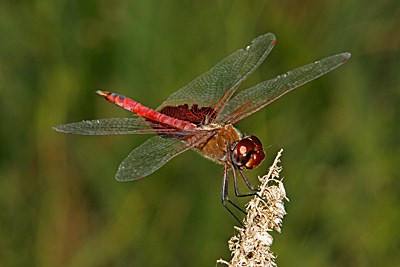
Red Saddlebags
Tramea onusta
- Habitat
- Open sky over ponds and lakes, generally in the southern and central United States, including Oklahoma
- Size
- About 1.7 to 1.9 inches (43–48 mm) long
- Lifespan
- Likely several weeks as a flying adult, similar to the related Black Saddlebags, though precise species-specific figures are not well documented
- Diet
- Adults catch flying insects on the wing, including small flies and flying ants; nymphs prey on aquatic invertebrates and small aquatic organisms
About the Red Saddlebags
The Red Saddlebags closely resembles its relative the Black Saddlebags in overall shape and flight style, but rather than black, it shows a warm red-orange body with matching reddish-brown patches at the base of each hindwing, again suggesting a pair of saddlebags slung beneath the dragonfly when viewed in flight. This reddish coloring, combined with its somewhat smaller size compared to the Black Saddlebags, is generally enough to separate the two species where their ranges overlap, though careful attention to the wing-patch color is worthwhile since both species can appear in the same open habitats.
It is found across the southern and central United States and into Mexico and Central America, and Oklahoma sits within its regular range, where it is most often seen flying over open ponds, lakes, and fields much like the Black Saddlebags, rather than perched at the water's edge the way smaller skimmers typically behave. Like its relative, it is built for extended gliding flight, with broad wings that let it cover open ground efficiently while searching for food or breeding sites, and it likewise tends to hang vertically from a twig on the rare occasions it does perch.
Adults hunt on the wing, catching small flying insects such as flies and flying ants during long patrol and foraging flights over open water and fields, a strategy shared with the Black Saddlebags and other high-flying glider species, and they may take advantage of temporary insect swarms when available. The aquatic nymphs live in ponds and lakes among sediment and submerged debris, where they act as ambush predators of aquatic invertebrates and other small aquatic organisms, using the same rapid-strike hinged jaw common to all dragonfly larvae.
Breeding occurs over open ponds and lakes, where males patrol territory and mate with visiting females, after which eggs are laid directly onto the water's surface, sometimes with the pair remaining in tandem during egg-laying. Like several related glider and saddlebags species, the Red Saddlebags is capable of substantial flight range and can appear at new water bodies somewhat unpredictably, making it, alongside the Black Saddlebags, one of the more far-ranging and less site-faithful dragonflies a visitor to Oklahoma's ponds and lakes might observe.
Frequently asked questions
How do I tell it apart from the Black Saddlebags?
Look for a red-orange body and matching reddish wing patches, rather than the solid black body and dark patches of the Black Saddlebags, along with its somewhat smaller size.
Where is it typically found?
Across the southern and central United States, including Oklahoma, usually flying over open ponds, lakes, and fields.
Does it perch often?
Rarely, and like its relative the Black Saddlebags, it usually hangs vertically from a twig rather than perching flat when it does rest.
What does it eat?
Adults catch small flying insects such as flies and flying ants during long flights over open water and fields.
Where to find it
This species favors wetland habitat. See real Oklahoma locations on the Habitats map.