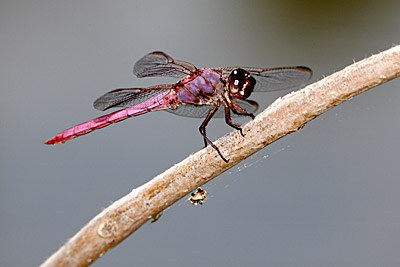
Roseate Skimmer
Orthemis ferruginea
- Habitat
- Ponds and still water, especially in warmer climates, ranging north from the southern United States into Oklahoma
- Size
- About 1.8 to 2.0 inches (46–51 mm) long
- Lifespan
- Probably several weeks as a flying adult, though precise figures specific to this species have not been well documented
- Diet
- Adults catch flying insects such as flies, mosquitoes, and small moths; nymphs prey on aquatic insect larvae and other invertebrates
About the Roseate Skimmer
The Roseate Skimmer is one of the few North American dragonflies with a genuinely pink to violet-rose body color in mature males, a shade unlike anything else in the skimmer family and one that makes correct identification unusually easy. The thorax often shows a deeper purplish tone than the abdomen, and the overall effect is a dragonfly that looks almost artificially colored when seen well in good light. Females and immature males are a warmer tan-brown instead, with a pale stripe along the thorax, gradually shifting toward the rosy coloring as males mature.
This species is most common across the warmer southern tier of the United States and into Mexico and Central America, and it has been steadily expanding its range northward over recent decades, likely aided by warming trends; Oklahoma lies within its more regularly used range, where it favors ponds, quiet lake edges, and other still-water habitats, including man-made ponds in parks and neighborhoods. It is a strong, fast flier and males often perch on bare twigs, wires, or other exposed spots overlooking open water rather than tucking into dense vegetation.
Adults hunt by darting from a perch to snatch small flying insects such as mosquitoes, flies, and moths out of the air, a technique typical of skimmers generally, and they can be quite aggressive in defending a favored perch against other dragonflies. The aquatic nymphs live among sediment and submerged vegetation, functioning as ambush predators that capture small aquatic invertebrates and insect larvae with a quick strike of the extendable labium.
Males are territorial over open water and mate with females that enter their territory, after which the female lays eggs by tapping the abdomen against the water's surface, sometimes while the male hovers guard nearby to deter rival males. Eggs develop into nymphs that live underwater, likely for roughly a year depending on temperature and food availability, before emerging to complete the transformation into the strikingly rose-colored adult. Its combination of unusual color and increasingly common presence in the region makes the Roseate Skimmer a rewarding find for anyone watching Oklahoma ponds during the warmer months.
Frequently asked questions
What makes the Roseate Skimmer so distinctive?
Mature males have a genuinely pink to violet-rose colored body, a shade not shared by any similarly common North American skimmer.
Is this a new arrival to Oklahoma?
The species has been expanding its range northward from warmer southern regions in recent decades, so it is more regularly seen in Oklahoma than it once was.
What do females look like?
Females and immature males are tan-brown with a pale side stripe on the thorax, rather than the rosy pink of mature males.
What does it eat?
Adults catch small flying insects such as mosquitoes and flies in mid-air, while nymphs feed on aquatic invertebrates underwater.
Where to find it
This species favors wetland habitat. See real Oklahoma locations on the Habitats map.