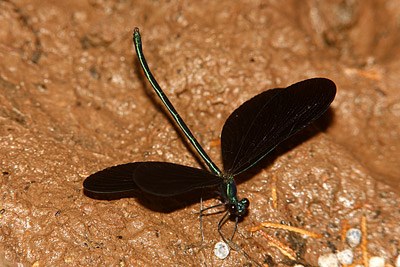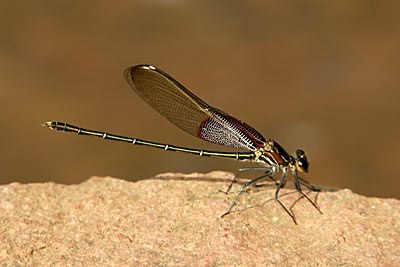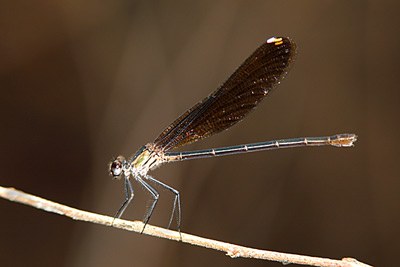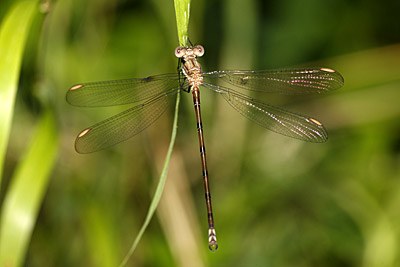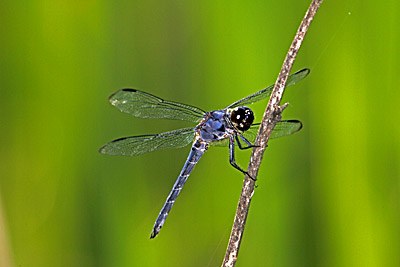
Slaty Skimmer
Libellula incesta
- Habitat
- Ponds, lakes, and slow streams, often near wooded edges, across the eastern and central United States
- Size
- About 2.0 to 2.2 inches (50–56 mm) long, a fairly large, solidly built skimmer
- Lifespan
- Likely several weeks as a flying adult, in line with other large skimmers, though precise figures are not well documented
- Diet
- Adults catch flying insects such as flies, moths, and mosquitoes in the air; nymphs prey on aquatic insect larvae and other small invertebrates
About the Slaty Skimmer
The Slaty Skimmer is named for the uniform slate-blue to blue-gray color that covers the mature male's entire body, unbroken by the stripes, spots, or wing patches seen on many related skimmers. The wings themselves are almost entirely clear except for a dark brown stigma near each tip, giving the species a plain, almost monochrome look that is actually one of its best field marks: a large, all-dark-blue skimmer with clear wings and no other markings is very likely this species. Females and immature males are brown rather than blue, with a pale stripe along the side of the thorax, and can be trickier to separate from other brown female skimmers at a glance.
It ranges across much of the eastern and central United States and is a regular presence at Oklahoma ponds and lakes, particularly those bordered by trees or shrubs; it tends to tolerate somewhat shadier, more sheltered water than some of the sun-loving skimmers on this list, and is often seen perching on twigs or reeds at the edge of woodland-fringed water bodies. It is also one of the larger common skimmers in the region, giving it a noticeably heavier, more powerful flight than smaller species sharing the same pond.
Adults hunt by perching and sallying out after passing insects, a classic skimmer strategy that lets them conserve energy between short, fast pursuit flights; prey is captured in a basket formed by the legs and delivered directly to the jaws while still airborne or immediately after landing. The aquatic nymphs, by contrast, are patient ambush hunters buried in bottom sediment or hidden among submerged plants, where they seize mosquito larvae, other aquatic insect nymphs, and small invertebrates using a rapid strike of their hinged, extendable labium.
Males defend territories along the shoreline and mate with females that enter their area, after which the female lays eggs by tapping her abdomen against the water's surface, sometimes while the male hovers nearby to guard against rival males. The resulting nymphs develop underwater, likely over the course of roughly a year depending on conditions, before finally crawling up out of the water on a plant stem to molt into the winged adult stage that eventually turns the deep slate-blue for which the species is named.
Frequently asked questions
What is the best way to identify a Slaty Skimmer?
Look for a large skimmer that is uniformly slate-blue all over with clear wings and no wing patches, spots, or stripes.
Do females look the same as males?
No, females and immature males are brown with a pale side stripe rather than blue, and lack the plain uniform look of mature males.
What kind of water does it prefer?
Ponds, lakes, and slow streams, often ones bordered by trees or shrubs rather than fully open, sunny water.
What does it eat as an adult?
It hunts flying insects such as flies, moths, and mosquitoes by darting out from a perch to catch them in the air.
Where to find it
This species favors wetland habitat. See real Oklahoma locations on the Habitats map.