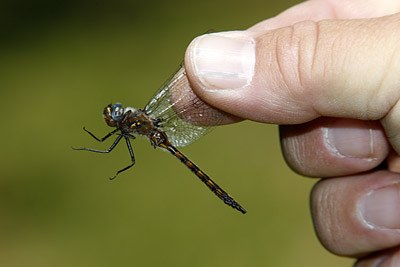
Slender Baskettail
Epitheca costalis
- Habitat
- Sand-bottomed lakes with moderate rooted vegetation, slow streams, and pools in clean rivers, typically within a few kilometers of where the adult emerged.
- Size
- About 1.5 to 1.9 inches (38-48 mm) long.
- Lifespan
- Not specifically documented; like most baskettails, adults have a relatively short, early-season flight period lasting a few weeks.
- Diet
- Adults catch small flying insects, often hunting in loose groups over open areas near water; nymphs prey on aquatic invertebrates on lake and stream bottoms.
About the Slender Baskettail
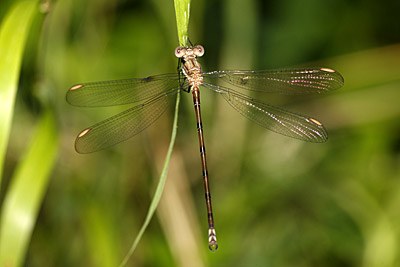
The Slender Baskettail is a dark brown emerald-family dragonfly with a notably narrow, constricted abdomen carrying small yellow markings along its sides, a build that sets it apart from the stockier Common Baskettail found in the same habitats. Its wings are clear, sometimes with a small basal spot on the hindwing, and its terminal appendages run slightly longer than those of related species, a detail specialists use to help confirm identification. Females occur in two forms, one of which shows a brown stripe along the leading edge of the wings and is largely restricted to the southeastern part of the species' range.
This species favors sand-bottomed lakes with moderate rooted vegetation, along with slow streams and pools in otherwise clean, flowing rivers, generally staying within a few kilometers of the water body where it originally emerged. Compared with the Common Baskettail, it tends to be found in habitats with somewhat sparser aquatic vegetation. Its overall range covers the eastern and central United States, reaching from states like Iowa and New Jersey south to Florida and west to Texas and the Gulf Coast, though it is absent from higher elevations in the Appalachians.
Like other baskettails, adults are early-season fliers, often seen hunting small flying insects in loose aggregations over fields, forest edges, and water, a behavior that can make baskettails easier to notice as a group even when individual species are tricky to tell apart. Their swift, erratic flight style is well suited to catching small prey on the wing.
The name 'baskettail' refers to the distinctive basket-shaped mass of eggs that the female extrudes and carries briefly at the tip of her abdomen before dipping it into the water to release the eggs. Nymphs of baskettails are notably spiny and camouflaged, living among sediment and debris on lake and stream bottoms through an extended larval period before emerging as adults. Because the various Epitheca baskettails look so similar to one another, confirming a Slender Baskettail sighting often comes down to examining wing spots and abdomen shape closely, ideally with a photograph in hand rather than a quick glance. Its early, compressed flight season also means most Oklahoma sightings cluster tightly into a few spring weeks each year rather than spreading across the whole summer.
Frequently asked questions
Where does the name 'baskettail' come from?
Females extrude a basket-shaped mass of eggs at the tip of the abdomen before dipping it into the water to release them.
How is the Slender Baskettail told apart from the Common Baskettail?
By its narrower, more constricted abdomen and slightly longer terminal appendages, along with habitat differences favoring sparser vegetation.
When is the best time to see a Slender Baskettail?
Early in the dragonfly season, since baskettails as a group are among the earlier fliers of the year.
What water conditions does it prefer?
Sand-bottomed lakes with moderate vegetation, slow streams, and pools in clean rivers.
Where to find it
This species favors wetland habitat. See real Oklahoma locations on the Habitats map.