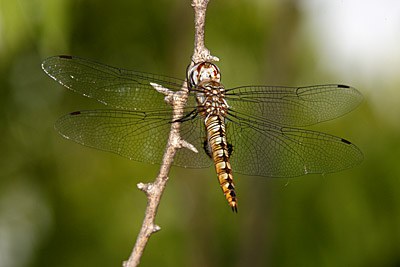
Spot-winged Glider
Pantala hymenaea
- Habitat
- Open sky over ponds, flooded fields, and temporary pools, similar to its close relative the Wandering Glider
- Size
- About 1.7 to 1.9 inches (44–49 mm) long
- Lifespan
- Individual adults likely live a few weeks; the species shares some of the migratory, wandering habits of its close relative the Wandering Glider
- Diet
- Adults catch small flying insects on the wing, including midges and flying ants; nymphs feed on aquatic invertebrates in temporary or still water
About the Spot-winged Glider
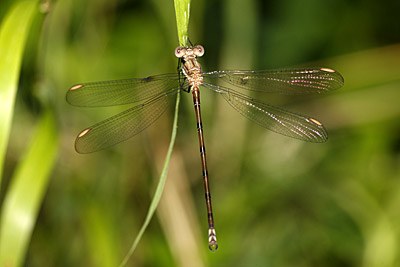
The Spot-winged Glider closely resembles its more famous relative, the Wandering Glider, in overall shape and golden-brown coloring, but it carries a distinctive dark brown patch at the base of each hindwing that the Wandering Glider lacks, which is the most reliable field mark for telling the two apart. Like the Wandering Glider, it has broad-based hindwings suited to gliding flight and spends the great majority of its time in the air rather than perched, giving both species a similar silhouette when seen cruising overhead.
It shares much of its habitat and behavior with the Wandering Glider, favoring open water, flooded fields, and temporary pools rather than settling at a single permanent pond, and it is often seen in Oklahoma as a wide-ranging seasonal visitor moving through the region rather than a fixed local resident. Both species can sometimes be seen flying together over the same open water, where the wing-spot becomes the easiest way to sort out which glider is which. Like other gliders, it is capable of substantial long-distance movement, following weather patterns and available breeding habitat, though it is not documented to undertake migrations on the same extreme scale as the Wandering Glider's ocean crossings.
Adults hunt in continuous flight, snapping up small flying insects such as midges and flying ants while gliding rather than sallying from a fixed perch, an efficient strategy for an insect that spends most of its life on the wing. The nymphs are adapted to develop quickly in short-lived pools and other temporary water bodies, a strategy shared with the Wandering Glider that lets both species colonize habitats that dry out too fast for most other dragonflies to use successfully.
Breeding follows the same temporary-pool strategy as its relative: females lay eggs in pools formed after rain, and nymphs must grow rapidly to complete development and emerge before the water disappears. This shared reliance on short-lived water, combined with strong flight and gliding ability, allows the Spot-winged Glider to appear opportunistically at new bodies of water across Oklahoma whenever conditions are right, often without warning and sometimes just as quickly moving on again.
Frequently asked questions
How do I tell it apart from the Wandering Glider?
Look for a dark brown patch at the base of each hindwing, which the similarly colored Wandering Glider lacks.
Does it perch like other dragonflies?
Rarely; like the Wandering Glider, it spends most of its time gliding over open water and fields rather than resting on vegetation.
Where does it breed?
In temporary pools and flooded areas, where the nymphs must develop quickly before the water dries up.
Is it a permanent resident of Oklahoma?
It behaves more like a wide-ranging seasonal visitor, appearing opportunistically at suitable water rather than staying at one pond year-round.
Where to find it
This species favors wetland habitat. See real Oklahoma locations on the Habitats map.