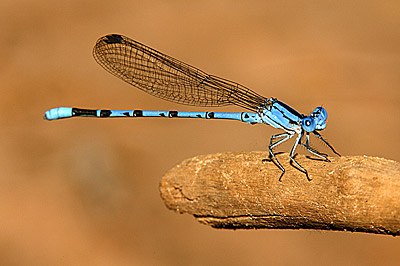
Springwater Dancer
Argia plana
- Habitat
- Spring-fed streams and creeks across the Great Plains
- Size
- About 1.1 to 1.4 inches (29-36 mm) long
- Lifespan
- Not well documented for this species specifically; adult dancers generally fly for a few weeks in season
- Diet
- Adults catch small flying insects near the water; nymphs feed on aquatic invertebrates
About the Springwater Dancer
Springwater Dancer is a Great Plains species whose name points directly to its preferred habitat: spring-fed streams and creeks with the more stable flow and temperature that spring sources provide. This affinity for spring-influenced water places it alongside a handful of other odonates that depend on the steadier conditions springs offer compared to purely runoff-fed streams, which can be more prone to drying up or flooding, and it shares this spring-loving tendency with species like the Turquoise Bluet, though the two typically occupy somewhat different stretches of the same watershed.
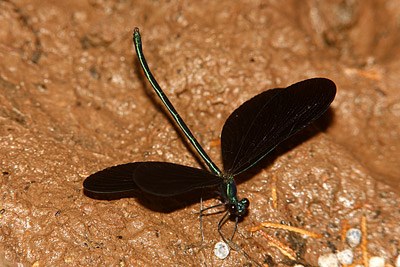
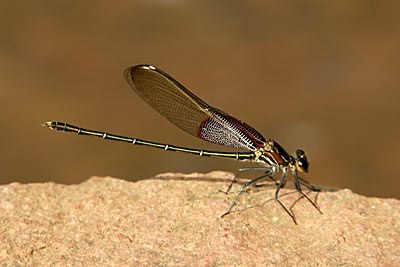
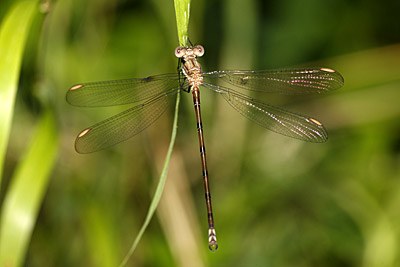
Mature males are blue, sharing the general look of several other Argia species found in Oklahoma, including a striped thorax and a mostly dark abdomen; as with most dancers, confident species identification in the field often depends on close inspection of the male's terminal abdominal appendages rather than color alone, since several blue dancers overlap broadly in general appearance. Females are typically duller and less patterned, adding to the challenge of field identification within this large genus.
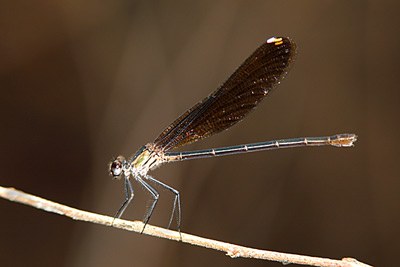
Adults are typically found perched low along stream banks, on rocks, gravel bars, or streamside vegetation, from where they make short flights to intercept small flying insects before returning to a nearby perch. This low-perching, sit-and-wait hunting style is characteristic of the genus and makes dancers relatively easy to observe once a productive stretch of stream bank has been located. Flight season likely extends through much of the warm season, tracking the relatively constant water temperatures that spring-fed streams maintain even as air temperatures fluctuate.
Breeding follows the typical Argia pattern: tandem pairs mate and then move to oviposition sites, with the male often remaining attached while the female lays eggs into submerged plant tissue near the water's edge, continuing to guard her against rival males until egg-laying is complete. Nymphs develop in the stream itself, benefiting from the more stable water levels and temperatures that spring-fed systems tend to provide, feeding on small aquatic invertebrates as they grow through successive molts before eventually emerging as winged adults.
Because it favors spring-fed water specifically, Springwater Dancer can be a useful indicator species for locating healthy spring systems within the Great Plains landscape of Oklahoma. Because springs tend to maintain more constant flow through drought periods than purely rain-fed streams, populations of Springwater Dancer may persist at a given site even during dry stretches when neighboring, non-spring-fed streams temporarily stop flowing, making the species a small but telling clue to which parts of a watershed are spring-supported.
Springs themselves are patchily distributed across the Great Plains, often tied to specific geological formations where groundwater reaches the surface, and this patchiness is mirrored in the somewhat scattered, localized distribution of Springwater Dancer populations across Oklahoma, which cluster tightly around known spring systems rather than spreading evenly across the state's stream network. Because spring water tends to emerge at a fairly constant year-round temperature, often cooler than summer air temperatures and warmer than winter ones, the immediate vicinity of a spring can support Springwater Dancer activity across an unusually long portion of the year compared with populations of the same species living along more temperature-variable, purely rain-fed stretches of the same stream. This localized, spring-dependent distribution also makes the species a useful target for citizen-science stream surveys aiming to map where the state's least-disturbed groundwater-fed systems remain active.
Frequently asked questions
Why is it called the Springwater Dancer?
It favors spring-fed streams and creeks, which tend to have steadier flow and temperature than purely runoff-fed waterways.
How do you identify a Springwater Dancer?
Mature males are blue with a striped thorax typical of Argia dancers, but confirming the species usually requires checking the male's abdominal appendages closely.
Where does the Springwater Dancer perch?
It typically perches low on rocks, gravel bars, or streamside vegetation right along the water's edge.
What does the Springwater Dancer's presence indicate?
Because it favors spring-fed streams, finding it can be a useful clue that a healthy spring system feeds the water nearby.
Why do springs matter so much to this species?
Springs provide steadier flow and temperature than rain-fed streams, letting Springwater Dancer populations persist even during dry spells when neighboring non-spring streams stop flowing.
Where to find it
This species favors wetland habitat. See real Oklahoma locations on the Habitats map.