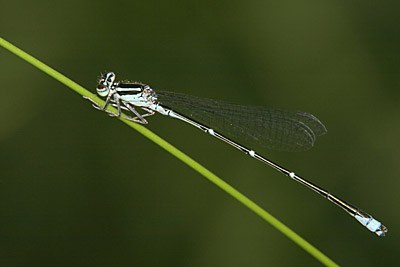
Stream Bluet
Enallagma exsulans
- Habitat
- Streams and rivers with moderate current, atypical among bluets for avoiding still water
- Size
- About 1.1 to 1.3 inches (28-34 mm) long
- Lifespan
- Not well documented for this species specifically; bluets generally fly for a few weeks as adults
- Diet
- Adults catch small flying insects; nymphs feed on aquatic invertebrates
About the Stream Bluet
Stream Bluet stands apart from most of its Enallagma relatives through simple habitat preference, which is also reflected directly in its common name. While most bluets are creatures of still or slow-moving water such as ponds, lakes, and marshes, Stream Bluet is instead strongly associated with flowing water, typically found along streams and rivers with moderate current rather than the calm backwaters favored by species like the Familiar Bluet. Enallagma is itself one of the larger damselfly genera in North America, and most of its many species are so similar in general appearance that habitat preference, as much as color pattern, often provides the first useful clue to identification.
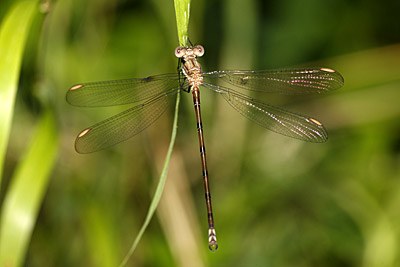
Mature males show the blue-and-black banded abdomen pattern typical of the genus, along with a blue thorax marked with black stripes, making them broadly similar in overall appearance to other bluets; distinguishing Stream Bluet from close relatives often comes down as much to habitat and behavior as to subtle differences in male abdominal appendages examined up close. Females are typically duller, often pale tan or greenish rather than blue.
Adults are usually seen perched on streamside vegetation or emergent plants growing in the current, from where they make short flights to capture small flying insects such as midges and gnats. Because they favor flowing water, Stream Bluets are often found in the company of dancers and other stream-associated damselflies rather than the pond-dwelling bluets and forktails typical of standing water. Flight season generally runs through the warmer months, with adults most numerous in mid-summer along suitable stream reaches.
Breeding follows a pattern generally similar to other bluets, with tandem pairs mating and females ovipositing into submerged plant tissue within the stream, sometimes on vegetation growing directly in moving water, the male often remaining attached to guard against rival males during the process. Nymphs develop within the stream itself, adapted to some degree of current, sheltering among aquatic plants, rocks, and debris while feeding on small aquatic invertebrates as they grow toward emergence.
This preference for flowing rather than still water makes Stream Bluet a useful example of how closely related damselfly species can partition habitat, with some genera and species specializing in ponds and others, like this one, specializing in streams. Because so few Oklahoma bluets specialize in flowing water the way this species does, Stream Bluet is a useful reminder that damselfly diversity in the state depends as much on the type of water present, whether still or flowing, as on the particular region or season.
Because Stream Bluet depends on current rather than still water, its local distribution tends to track the availability of moderate-flow stream reaches rather than any particular region of the state, and it can be found alongside dancers and clubtails in similar stretches of river even where pond-dwelling bluets are entirely absent nearby. The species also appears somewhat more tolerant of slightly cooler, faster water than some of its pond-dwelling relatives, a trait that likely reflects a longer evolutionary association with flowing habitats rather than a recent shift away from still water. Observers used to finding bluets by scanning open pond edges often need to adjust their search image when looking for this species, checking streamside grasses and low branches overhanging moving water instead. Because current speed and streambed character can vary considerably along a single river, a stretch that looks superficially uniform to a human observer may in fact hold quite different concentrations of Stream Bluets depending on subtle differences invisible at a casual glance.
Frequently asked questions
What makes the Stream Bluet unusual among bluets?
Unlike most bluets, which favor still water such as ponds and lakes, Stream Bluet prefers flowing streams and rivers with moderate current.
How does the Stream Bluet look compared to other bluets?
Mature males show the typical blue thorax with black stripes and a banded blue-and-black abdomen shared across the genus Enallagma.
What other damselflies might be found alongside Stream Bluets?
Because it favors flowing water, it is often found near stream-associated dancers rather than pond-dwelling bluets and forktails.
Where do Stream Bluet nymphs develop?
They develop within the stream itself, sheltering among aquatic plants, rocks, and debris in moving water.
How large is the genus Enallagma, which Stream Bluet belongs to?
It is one of the larger damselfly genera in North America, with many similar-looking species, which is why habitat preference is often as useful for identification as color pattern.
Where to find it
This species favors wetland habitat. See real Oklahoma locations on the Habitats map.