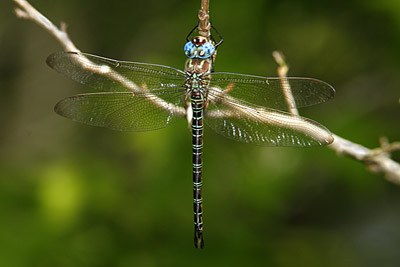
Swamp Darner
Epiaeschna heros
- Habitat
- Shaded woodland ponds, swamps, temporary pools, and slow shady streams; adults also range well away from water into fields and forest edges to hunt.
- Size
- About 3.3 to 3.9 inches (83-99 mm) long, one of the largest dragonflies in North America.
- Lifespan
- Not precisely documented for this species; large darners in the Aeshnidae family typically live several weeks as flying adults, so a similar range is a reasonable estimate rather than a confirmed figure.
- Diet
- Adults take flying insects on the wing, including moths, flies, and other mid-sized insects, often foraging at dusk under tree canopy; nymphs prey on aquatic invertebrates and other insect larvae in leaf litter and debris on pond bottoms.
About the Swamp Darner
The Swamp Darner is a giant among Oklahoma dragonflies, with a deep chocolate-brown body crossed by two bold, diagonal neon-green stripes on each side of the thorax. Its enormous compound eyes meet in a seam along the top of the head and shine a brilliant blue-green, giving it an almost alien profile in flight. Males have blue-tinted eyes on a brown face, while females carry a slightly thicker abdomen and duller eye color. The wings start out perfectly clear and often pick up a smoky amber wash near the tips as the insect ages.
This species favors quiet, plant-choked water in shaded settings: woodland ponds, backwater swamps, and slow-moving forest streams, including pools that dry up later in the season. Its range covers most of the eastern United States and extends west through Oklahoma into Texas. Swamp Darners are also one of the relatively small number of dragonfly species known to make long-distance migratory flights, with concentrations reported moving along the Atlantic coast in some years, occasionally reaching as far as the Bahamas.
Unlike many dragonflies that stay tethered to open water, Swamp Darners frequently forage far from ponds and streams, cruising along wood edges and over fields in the low light of dusk and dawn to snap up flying insects. Their large size and powerful, continuous flight let them cover a lot of ground while hunting, and they are often noticed more by the sound of their wings than by a clear view of the insect itself.
Females have an unusual egg-laying habit: rather than depositing eggs directly into open water, they insert them into wet, rotting wood or waterlogged bark above the waterline, including logs and stumps at the pond's edge. The larvae eventually make their way into the water to complete a nymphal stage that, as in most darners, likely spans a year or more before the adult dragonfly emerges the following season. Like all dragonflies, the Swamp Darner develops through incomplete metamorphosis, with the aquatic nymph molting repeatedly before an adult ever takes wing and no pupal stage in between. Its sheer bulk, among the greatest of any North American dragonfly, also makes a newly emerged adult an easy target for birds hunting over water before its flight muscles fully harden.
Frequently asked questions
Why is the Swamp Darner considered unusual among dragonflies?
It is one of only a small number of North American dragonfly species known to undertake long migratory flights, sometimes moving in loose groups over long distances.
Where do Swamp Darners lay their eggs?
Females insert eggs into wet, rotting wood or bark above the waterline rather than directly into open water, which is unusual for a darner.
Is the Swamp Darner dangerous to people?
No, it cannot sting and its bite is not a health concern; it is a harmless predator of other insects.
What time of day is best for spotting a Swamp Darner?
Look near dusk or dawn along shaded pond and stream edges, when this species is most active hunting flying insects.
Where to find it
This species favors wetland habitat. See real Oklahoma locations on the Habitats map.