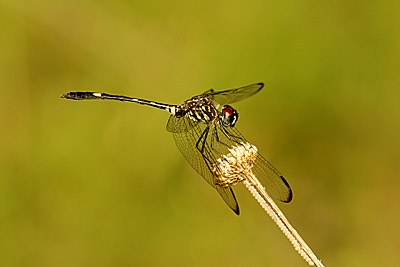
Swift Setwing
Dythemis velox
- Habitat
- Streams and rivers with slow to moderate current, usually bordered by wooded or shrubby banks; less often found at pond and lake shores.
- Size
- About 2 inches (roughly 50 mm) long.
- Lifespan
- Not specifically documented; likely a few weeks as an adult, consistent with related setwing skimmers.
- Diet
- Adults catch flying insects near flowing water; nymphs prey on aquatic invertebrates in stream sediment.
About the Swift Setwing
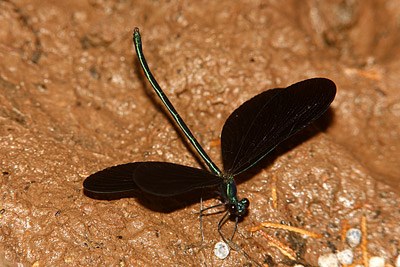
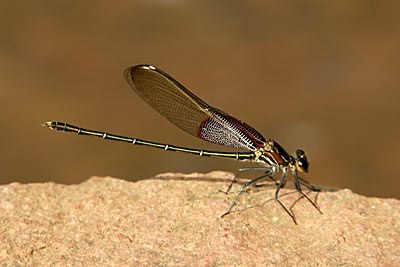
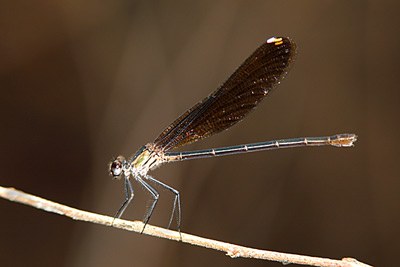
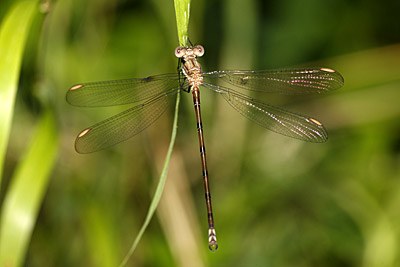
The Swift Setwing is a neotropical skimmer known for one particularly unusual habit: rather than holding its wings out to the sides like a biplane, as most perched dragonflies do, it angles them forward toward its face, the behavior that gives the whole setwing group its common name. Its thorax carries a complex black pattern over a bluish-cream background, while the abdomen is yellow at the base and mostly black further along, with small yellow spots running down the top. In flight, the black-tipped wings are a useful field mark that helps confirm identification even before the forward-set perching posture is visible.
This species favors streams and rivers with slow to moderate current, typically bordered by wooded or shrubby banks, though it is occasionally found at pond and lake shores as well. Its range includes several states in Mexico along with more than a dozen U.S. states, including Oklahoma and Texas, and there is evidence of a gradual eastward range expansion in recent decades, suggesting the species has been slowly extending its distribution beyond its historical core range.
Adults hunt flying insects near their home waters, likely combining perching with short pursuit flights in the manner typical of setwing skimmers, though the forward-wing perching posture remains the most distinctive and easily noticed behavioral trait of the species.
Breeding follows the general pattern expected of a flowing-water skimmer, with females laying eggs into the current and nymphs developing among sediment and debris on the streambed, preying on other aquatic invertebrates through an extended larval period before emerging as winged adults. Because the Swift Setwing appears to be gradually expanding its range eastward, it is a species worth watching for at new localities, and its unmistakable forward-wing perching habit makes positive identification straightforward once an observer has learned to look for it. Because the forward-wing perching posture is so distinctive, it is often the quickest way to confirm a Swift Setwing sighting even at a distance, well before finer color details can be made out. Its documented eastward range expansion in recent decades also makes it a species worth reporting carefully if found somewhere outside its previously known range, since such records can help track the shift over time.
Frequently asked questions
What is unusual about how the Swift Setwing perches?
It angles its wings forward toward its face rather than holding them out to the sides like most dragonflies, the trait that gives setwings their name.
What kind of water does it prefer?
Streams and rivers with slow to moderate current and wooded or shrubby banks, occasionally pond and lake shores.
Is its range changing over time?
Yes, there is evidence of a gradual eastward range expansion for this species in recent decades.
How can you recognize a Swift Setwing in flight?
Look for black-tipped wings along with a yellow-based, mostly black abdomen marked with small yellow spots.
Where to find it
This species favors wetland habitat. See real Oklahoma locations on the Habitats map.