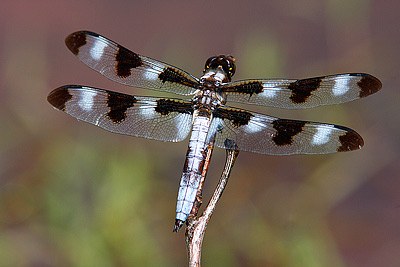
Twelve-spotted Skimmer
Libellula pulchella
- Habitat
- Ponds, lakes, and marshes with open water and emergent vegetation across most of the United States
- Size
- About 2.0 to 2.2 inches (50–56 mm) long, one of the larger common skimmers
- Lifespan
- Likely several weeks as a flying adult, consistent with other large skimmers, though precise field data is limited
- Diet
- Adults catch flying insects such as flies, moths, mosquitoes, and sometimes smaller dragonflies or damselflies; nymphs prey on aquatic insect larvae and other invertebrates
About the Twelve-spotted Skimmer
The Twelve-spotted Skimmer gets its name from the three dark brown patches on each of its four wings, a total of twelve spots, which make it one of the more instantly recognizable dragonflies at any pond. As males mature, they add bright white patches between and beyond the brown ones, producing an alternating brown-and-white banded pattern across all four wings that is unmistakable in flight; females and immature males keep the brown spots but lack the white ones, giving them a plainer, more uniformly patterned wing. The body itself is brown in females and immatures, shifting to a pale grayish-blue pruinosity on the abdomen of mature males.
It is a widespread and common species found across nearly the entire United States and much of Oklahoma, favoring open ponds, lakes, and marshy areas with a mix of open water and emergent plants like cattails and rushes. It is a strong, fast flier and often patrols back and forth over open water for extended stretches rather than perching as persistently as some other skimmers, though males do return to favored lookout perches between patrol flights.
Adults are opportunistic aerial hunters, catching a wide variety of flying insects on the wing, including flies, moths, and mosquitoes, and are large and fast enough to occasionally take smaller dragonflies or damselflies as well. The aquatic nymphs are bottom-dwelling ambush predators, hidden among sediment, detritus, or submerged plants, where they capture aquatic insect larvae and other small invertebrates using a quick strike of their extendable hinged labium.
Males establish territories over open water and defend them vigorously against rivals, often engaging in fast chases and aerial displays of the banded wing pattern. After mating, females lay eggs by tapping the abdomen against the water's surface while in flight, typically without the male continuing to guard her directly, in contrast to some other skimmer species. Eggs develop into nymphs that live underwater for roughly a year or more, depending on water temperature and food availability, before finally climbing out of the water on an emergent stem to molt into the banded, twelve-spotted adult.
Frequently asked questions
Why does it have twelve spots?
Each of its four wings carries three dark brown patches, adding up to twelve spots total, which gives the species its name.
How do males differ from females in appearance?
Mature males add white patches between the brown wing spots and develop a pale bluish body, while females and young males show only the brown spots on a brown body.
Where is it commonly found?
It is widespread across most of the United States, favoring open ponds, lakes, and marshes with a mix of open water and emergent vegetation.
Does it eat other dragonflies?
It mainly eats flies, moths, and mosquitoes, but being large and fast, it can occasionally catch smaller dragonflies or damselflies too.
Where to find it
This species favors wetland habitat. See real Oklahoma locations on the Habitats map.