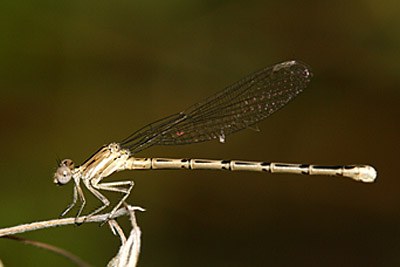
Variable Dancer
Argia fumipennis
- Habitat
- Ponds and slow streams with vegetated margins
- Size
- About 1.1 to 1.4 inches (28-35 mm) long
- Lifespan
- Not well documented for this species specifically; adult dancers in general fly for a few weeks in season
- Diet
- Adults prey on small flying insects; nymphs feed on aquatic invertebrates in the water
About the Variable Dancer
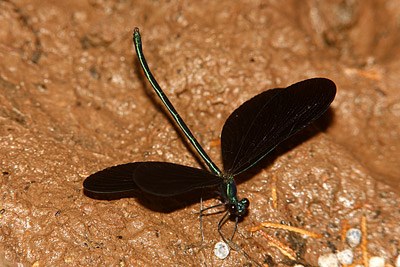
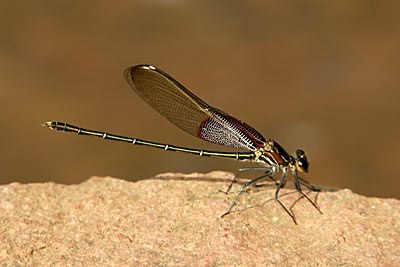
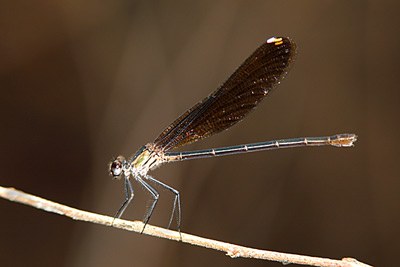
Variable Dancer earns its name honestly: it is one of the most color-variable damselflies in its genus, with mature males ranging from violet-purple to blue depending on subspecies and individual variation, while the scientific name fumipennis, meaning smoky-winged, refers to the faintly tinted wings shown by some populations, particularly the violet-colored form sometimes recognized as a distinct subspecies. This variability has made the species a long-running subject of interest for people trying to sort out dancer identification in the field.
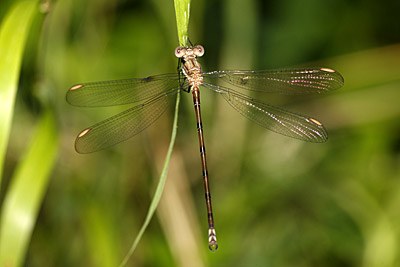
Regardless of exact coloration, Variable Dancers share the general Argia body plan: a slender frame, a thorax patterned with pale and dark stripes, and a mostly dark abdomen. Females are typically duller, often brownish or grayish, which is typical of the genus and makes males the more reliable subject for identification.
This species is found around ponds, lake margins, and slow-flowing streams with reasonable amounts of shoreline or emergent vegetation, where adults perch on plants, rocks, or bare ground close to the water. Like other dancers, it hunts by making short flights from a perch to catch small flying insects such as gnats and midges, returning afterward to consume its catch and watch for the next opportunity.
Breeding follows the pattern typical of the genus: males and females pair in tandem, with the male often continuing to grip the female behind the head while she lays eggs into submerged plant tissue, a guarding behavior that helps protect his paternity of the resulting eggs. The nymphs that hatch live underwater among vegetation and debris, feeding on small aquatic invertebrates as they grow through several molts before eventually climbing out of the water to emerge as winged adults. Because Variable Dancer tolerates a fairly wide range of still and slow-moving water habitats, it is one of the more broadly distributed dancers likely to turn up at everyday ponds as well as larger streams across Oklahoma. In Oklahoma, most individuals show blue rather than the violet coloration associated with subspecies found farther east, though some regional variation in male color intensity has been noted by observers comparing populations across the species' broad range. This kind of intraspecific color variation is part of what originally earned the species its common name.
Frequently asked questions
Why is it called the Variable Dancer?
Its mature males show unusually variable coloration, ranging from violet-purple to blue depending on the population, unlike most dancers with a fairly fixed male color.
What does the species name fumipennis mean?
It refers to smoky-tinted wings shown by some populations of this species, most notably violet-colored individuals.
What kind of water does the Variable Dancer prefer?
It is found around ponds, lake edges, and slow streams that have shoreline or emergent vegetation for perching.
How do Variable Dancers mate?
Pairs join in tandem, with the male continuing to grip the female while she lays eggs into submerged plants, a mate-guarding behavior common in the genus.
Where to find it
This species favors wetland habitat. See real Oklahoma locations on the Habitats map.