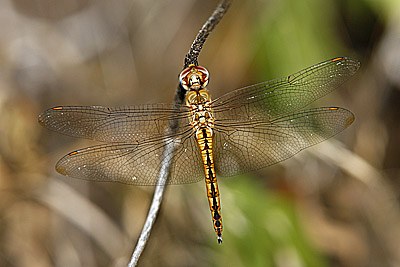
Wandering Glider
Pantala flavescens
- Habitat
- Open sky over ponds, flooded fields, and temporary rain pools; rarely perches, and breeds in short-lived water bodies
- Size
- About 1.7 to 1.9 inches (44–48 mm) long, with unusually broad-based hindwings for extended gliding flight
- Lifespan
- Individual adults likely live only a few weeks, but the species is famous for multi-generational migrations covering thousands of miles, among the longest migrations known in any insect
- Diet
- Adults catch small flying insects, especially midges, flying ants, and other tiny insects caught while on the wing; nymphs feed on aquatic invertebrates in temporary pools
About the Wandering Glider
The Wandering Glider, also widely known by its other common name, the Globe Skimmer, is a golden-amber colored dragonfly built for endurance flight rather than perching. Its hindwings are unusually broad at the base compared to most skimmers, an adaptation that lets it glide efficiently on rising air currents and cover far greater distances with less energy expenditure than a typical dragonfly. It is rarely seen perched, spending most of daylight hours cruising steadily over open ground, often high above the vegetation where other skimmers hunt, which alone makes it fairly easy to pick out even before its color is confirmed.
This is widely considered the most globally distributed dragonfly species on the planet, found on every continent except Antarctica, and it is renowned among entomologists for undertaking one of the longest migrations known in the insect world. Populations are known to cross the Indian Ocean between East Africa and India, a nonstop journey of well over a thousand miles for individual dragonflies, as part of multigenerational migrations that researchers have estimated can span many thousands of miles in total when tracked across successive generations. In Oklahoma, it is a wide-ranging, often seasonal visitor rather than a permanent resident, showing up over ponds, flooded fields, and other open water, sometimes in large loose swarms.
Adults hunt on the wing, snapping up small flying insects such as midges and flying ants during their long gliding flights rather than sallying from a fixed perch the way most skimmers do, which fits their more or less continuous airborne lifestyle. The nymphs, by contrast, are specialized for a very different challenge: they develop unusually fast in short-lived rain pools, puddles, and other temporary water bodies that can dry up within weeks, a strategy that lets the species colonize habitats too unpredictable for most other dragonflies to use.
Breeding is tied directly to this fast-pool strategy: females lay eggs in temporary pools soon after rain, and the resulting nymphs must grow and emerge quickly before their pool evaporates, a race against the clock that has shaped much of the species' unusual biology and its wandering, opportunistic habits.
Frequently asked questions
Why is it called the Wandering Glider?
Its broad-based hindwings let it glide efficiently over long distances, and the species is known for extensive, sometimes ocean-crossing migrations.
Is this really the most widespread dragonfly on Earth?
Yes, it is generally considered the most globally distributed dragonfly species, found on every continent except Antarctica.
Where does it lay its eggs?
It breeds in short-lived rain pools and other temporary water bodies, where nymphs must develop quickly before the water dries up.
Will I see it perched on a plant like other dragonflies?
Rarely; it spends most of its time cruising and gliding over open water and fields rather than resting on vegetation.
Where to find it
This species favors wetland habitat. See real Oklahoma locations on the Habitats map.