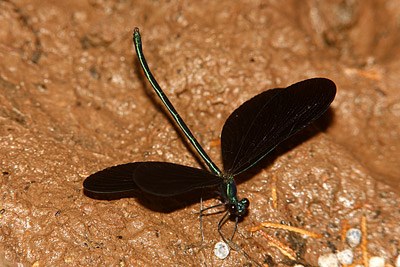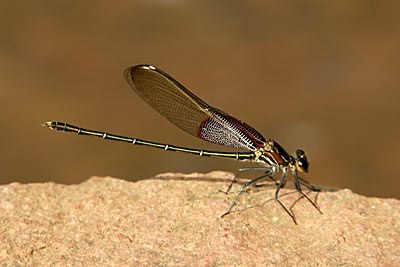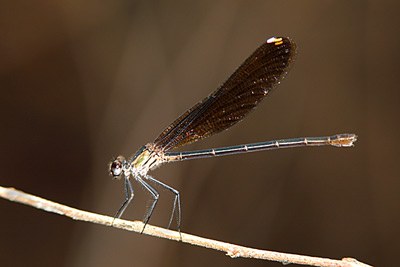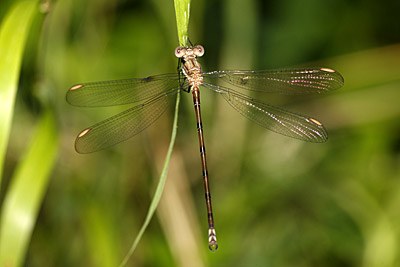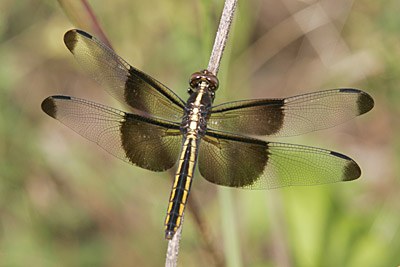
Widow Skimmer
Libellula luctuosa
- Habitat
- Ponds, lakes, and slow streams with open, sunny shoreline, common throughout Oklahoma
- Size
- About 1.7 to 2.0 inches (43–51 mm) long
- Lifespan
- Generally a few weeks as a flying adult during the summer season, though exact wild lifespans are not precisely documented
- Diet
- Adults hawk flying insects including mosquitoes, flies, and small moths; nymphs prey on aquatic insect larvae and other small invertebrates
About the Widow Skimmer
The Widow Skimmer is easy to recognize by the bold, dark brown-to-black patch that covers the base of each wing in both sexes. As males mature, they add a second, whiter patch just beyond the dark one on each wing, along with a powdery blue coating over the abdomen, creating a striking black-and-white banded wing pattern in flight. Females and immature males lack the white patches and blue pruinosity, showing instead a brown body with pale yellow side stripes and just the dark basal wing patches, which is thought to be the origin of the "widow" name, evoking the dark, somber dress once associated with mourning.
This is one of the most common and widespread skimmers in Oklahoma, turning up at almost any pond, lake, or slow stream with open, sunny shoreline and some fringing vegetation. It tolerates a wide range of water bodies, from farm ponds to city park lakes, and is often one of the first larger dragonflies a visitor to open water will notice, thanks to its size and the flashing black-and-white wing pattern of territorial males in flight.
Adults hunt on the wing, darting from a favored perch on a grass stem, shrub, or fence wire to snatch mosquitoes, flies, and other small flying insects, then typically returning to the same or a nearby perch to consume the catch. Nymphs live underwater among plants and sediment, where they are ambush predators, seizing mosquito larvae and other small aquatic invertebrates using a fast-striking, extendable hinged jaw.
Males are strongly territorial over open water, patrolling and displaying their banded wings to rivals, and mate with females that enter their territory. Afterward, the female lays eggs by tapping the tip of her abdomen against the water's surface while flying, often with the male hovering nearby to guard against other males. The eggs hatch into nymphs that spend roughly a year or more developing underwater before finally emerging, climbing a plant stem out of the water to complete the transformation into a winged adult, at which point the fresh dragonfly must wait for its wings to harden before taking its first flight.
Frequently asked questions
Why is it called the Widow Skimmer?
The dark wing patches on females and young males were likened to the somber dark clothing traditionally worn by widows in mourning.
How do males differ from females?
Mature males add a white patch beyond the dark basal wing patch and develop a powdery blue body, while females and young males stay brown with only the dark wing patches.
Is this a common dragonfly in Oklahoma?
Yes, it is one of the most frequently seen skimmers statewide, found at almost any sunny pond, lake, or slow stream.
What do adults eat?
They catch small flying insects such as mosquitoes and flies in mid-air, usually from a favorite perch near the water.
Where to find it
This species favors wetland habitat. See real Oklahoma locations on the Habitats map.